Pages

Monday, April 1, 2013

Little Golden Books


Spring always sends me skipping into a bookstore or library in search of fresh picture books with bright hues and enchanting stories. I look for nonfiction hardcovers with crisp photographs of backhoes and barnyard animals. I seek lively joke books and cheery bedtime stories. Sometimes, all I look for is a little flash of gold.


That gold is the distinctive foil spine of the Little Golden Books series. For over 70 years, generations of children have looked for the golden binding, knowing that great stories are there for the taking. Little Golden Books contain quality writing and art from some of the biggest names in the publishing business. They are perfectly sized for small hands, and are recommended for ages 2-6.


Classic stories and new titles are available through Random House. Some are available with a CD, others in boxed sets. There are so many titles that I can’t tell you about them all, so I have picked out some of my own family favorites to get your family started.


Gertrude Campton wrote two of our favorite classics, Tootle (1945) and Scuffy the Tugboat (1946), both pleasingly illustrated by Tibor Gergely. Tootle is a baby locomotive who struggles to follow the rules, especially Staying on the Rails No Matter What. Scuffy is a toy boat that is dissatisfied with sailing in a bathtub, “I was meant for bigger things,” he says, and sets off to seek adventure.  Both stories are engaging and they reinforce the virtues of prudence and temperance.


Based on a motion picture by Dr. Seuss, Gerald McBoing Boing (1950) is such fun to read aloud. Gerald is a boy who doesn’t speak words. No one knows what to do with Gerald; he doesn’t fit in at school or at play. Then he meets someone who appreciates his unusual talent and helps Gerald put it to good use. “Now Gerald is rich, / he has friends, he’s well fed, / ‘Cause he doesn’t speak words, / he goes boing boing instead!”

Prayers for Children (1952) is a sweet little book reverently illustrated by Eloise Wilkin. Her beatific children are shown at prayer while going about the simple events of the day.  This is a lovely book with which to begin a foundation in virtue and establish the habit of prayer in your children. There is a whole collection of Golden Books Inspirational to help parents share biblical stories with children.


 Kathryn Jackson’s adorable story, Tawny Scrawny Lion (1952), illustrated by Gustaf Tenggren, is the tale of a lion who never could get enough to eat – that is, until he became a vegetarian! What a fun way to teach the virtue of kindness. If you remember the audio book from 1976 with the wonderful song, “Carrot Stew,” you can listen to it again at MouseVinyl.com. Here's the link.


 Garth Williams illustrated some of the most wonderful books of the 20th century, including “Charlotte’s Web”, the “Little House” series, and “The Cricket in Times Square.” He also applied his talent to a number of Little Golden Books such as Baby Farm Animals (1953), and Home for a Bunny, by Margaret Wise Brown (1956). Williams is a master of conveying texture. His animals are so appealingly bright-eyed and playful that readers want to pet the fluffy rabbits, piglets and puppies. Charming!


Little Golden Books also offers a number of books starring favorite characters that children recognize from TV and movies: Thomas and Friends, Barbie, Disney, and Sesame Street. Our favorite for four decades now is, The Monster at the End of This Book (1971), written by Jon Stone, illustrated by Mike Smollin, and starring your loveable, furry old pal Grover. Grover wants to stop the reader from turning pages to avoid getting closer to the monster at the end. The story has been adapted to a very entertaining ebook with classic Grover humor and great sound effects, but physically turning the page is so important to this story. Also, it is such fun to scream and whisper in a Grover voice. Best bet: share the book, love the book and later, for added fun, enjoy the ebook.

The Little Golden Book of Jokes and Riddles (2013) has funny, mid-century modern looking illustrations by David Sheldon which compliment the wacky jokes collected here by Peggy Brown. Perfect for kids who are just learning the art of telling a joke.


 Anne Kennedy illustrates the classic song, Old MacDonald Had a Farm (2013). You’ll find comfort in the familiar text and tune, but take a look at the surprising events going on at the farm!


Collections of high-quality stories illustrated by artists dedicated to beauty are important to have in your home so that children may return to them again and again. A shelf full of Little Golden Books will always be a treasured.


Michelle Clark wishes she had the ENTIRE Golden Books collection as well as the World of Peter Rabbit box set, but then that’s what the library is for. 

Friday, February 1, 2013

"Point To Happy" (Autism); "Knees" (Dyslexia); and "The Princess and the Peanut" (Allergies)


Communication is a major reason for reading any book to a child. When we read together we foster closeness, language acquisition, and values. Sometimes special circumstances require specialized books to help alleviate fears, overcome obstacles and enlighten the unaware. 

When a child has difficulties communicating his needs or feelings, books like Point To Happy, by Miriam Smith and Afton Fraser (Workman Publishing, 2011) can help.

With simple text and clear, large photographs, “Point To Happy” is intended to aid kids on the autism spectrum in expressing themselves and detecting the feelings of others. The attached pointer wand helps a child focus as he selects the appropriate pictures when the text is read. Photos illustrate emotions, objects and everyday activities. There is also a blank page for adding pictures of family and friends.

The grandmother, mother and aunt of an autistic child created “Point To Happy”. It is cleanly presented and well thought out. The book is oversized and sturdy for repeated use.

Though it is intended for autistic spectrum children, any toddler will benefit from the decoding and motor tasks fostered by this book. It offers kids practice in recognizing colors and parts of the body. Young children also need to study facial expressions and body language in order to empathize with others, and this book is a great way to reinforce those lessons.  

School-age children sometimes struggle with learning differences. Offering encouragement to dyslexic children is Vanita Oelschlager’s book, Knees: The Mixed-Up World of a Boy With Dyslexia (Vanita Books, 2012).

The main character Louis finds school frustrating, explaining that, “things get mixed up between my eyes and my brain.” Sometimes he feels bad. With patient teachers, loving parents and a few good friends, Louis perseveres. His dad tells Louis, “We’re all good at something. You just have to find it.”

“Knees” clearly explains what dyslexia is like for a fourth-grader. The simple text is written in rhyming couplets that keep the story flowing. Energetic pen and ink illustrations by Joe Rossi are a friendly invitation to read this book over and again, and perhaps even color the pages.

This is a nice book to offer some comfort and understanding to a child who has been diagnosed with dyslexia. Informative and entertaining, it is a great choice as a read-aloud for teachers who want to help other students better understand the challenges faced by a fellow classmate.

Children who suffer from allergies might want to read about their circumstance, too. The Princess and the Peanut: A Royal Allergic Fairy Tale, by Sue Ganz-Schmitt (Wild Indigo Publishing, 2011) helps kids ages 4-9 learn about food allergies through a story that borrows elements from the classic fairy tale “The Princess and the Pea.”

A young prince yearns for a real princess to be his wife, so he searches around the world but doesn’t find a girl who is quite right. In the middle of a storm, a dirty, wet young girl knocks at the gate and claims to be a real princess.

Instead of placing a pea under twenty mattresses, this book puts a peanut there. The sensitive princess breaks out in hives and must receive an Epinephrine injection and be looked after carefully for a few days.

When the princess, feeling sad, asks, “Why me?” the doctor magnanimously replies, “Ahh, but princesses are extraordinary, and extraordinary people have great sensitivities.”

The cute story with amusing illustrations isn’t just entertaining, it provides accurate information about what really happens when someone has a severe allergic reaction. “The Princess and the Peanut” helps take some of the scary out of such a situation.  


Find more suggestions for good books at http://clarkbookmark.blogspot.com

Tuesday, January 1, 2013

Cozy Up With A Classic


Histories and classics are sometimes forgotten by the young reader because he has so many choices at the library. Often it is the newest releases that are prominently displayed and thus garner the most attention. The books suggested here are a nice combination of history, classic story and innovation. Perhaps one will end up in your hands.


Cozy Classics: Pride and Prejudice
by Jack and Holman Wang
Simply Read Books, 2012

I loved this book before I even opened it. The idea – making a board book out of Jane Austen’s most treasured novel – is just too delicious for words. And the cover! Look at dear Elizabeth Bennet protecting her bonnet from the wind and tugging at her muddy skirts. Priceless.

Brothers Jack and Holman Wang condensed Pride and Prejudice down to twelve toddler-friendly words. Then they created and photographed sculptured dolls to illustrate the simplified story. The Wang brothers make the dolls by needle felting: using a barbed needle to tangle and compact wool fibers, forming three-dimensional felt sculptures. They are remarkably lively and absolutely beautiful.

Cozy Classics: Pride and Prejudice is the result. The first spread displays the word “friends” and we see Mr. Bingley smiling, his hand on the shoulder of Mr. Darcy. They are standing in front of the first page of the novel where we can just make out that oh-so famous opening line, “It is a truth universally acknowledged…” Delightful!

Cozy Classics: Pride and Prejudice is a must-read for moms who love Austen. Also available is “Cozy Classic: Moby Dick,” and coming this spring, parents can enjoy sharing a cozy version of Victor Hugo’s “Les Miserables” and Leo Tolstoy’s “War and Peace” with their very young children.


Magic Tree House #47: Abe Lincoln At Last!
by Mary Pope Osborne
Random House, 2011

Beginning and middle readers may be interested by the extensive promotion of Spielberg’s movie “Lincoln.” Though they are too young to see the film, children can get in on the history by reading Mary Pope Osborne’s Magic Tree House #47 Abe Lincoln at Last! Osborne guides readers on a journey of the imagination to Washington, D.C. in the year 1861 to give the president a message of hope.

Osborne’s tremendous Tree House series is beloved by so many because its main characters, Jack and Annie, are smart, funny kids who are sent on some pretty unbelievable adventures to visit places where real history happened.

That special blend of fiction and fact often inspires a thirst for more information about a featured topic, so the folks from the Tree House series created nonfiction supplements. In this case, the Magic Tree House Fact Tracker: Abraham Lincoln is a resource with information about life in a log cabin, what a blab school was like, and what headlines were in the newspapers in 1837. Did you know that Lincoln held a patent for an invention that would make boats lighter whenever they got stuck? Me neither.


Jane
by April Lindner
Poppy, 2011

For your teenager who was obliged to read Charlotte Bronte’s Jane Eyre at school and actually sort of liked it, there is a fun reimagining of that classic in April Lindner’s novel, Jane.  

Lindner modernizes the tale by wondering what would happen if a Jane Eyre were to fall in love with a rock star. Her character Jane Moore is the new nanny at Thornfield Park, home to world-famous rock musician Nico Rathburn. Fans of the classic novel will enjoy how Lindner is able to pay homage to the original while telling an emotional and engagingly modern story. It’s a great romance. The book is entertaining even to those who have never heard of Bronte.

I thoroughly enjoyed this book, with one caveat: Jane Moore has a physically intimate encounter with Nico just before she flees Thornfield Park. I have to say that I was disappointed. Lindner’s main characters are so evocative of Eyre and Rochester that I felt truly let down that Rathburn wasn’t willing, for Jane’s sake, to keep from going too far. Sex may be part of the protocol in modern romances, but here it is dissonance.


CLASSIC CHOICE

Probably the most classical you can get, story-wise, is to read Homer’s Iliad and Odyssey – epic poems of heroism and hubris that have been translated and retold by many. If you are looking for a nice translation to read to your family, consider one of these:


The Adventures of Odysseus and The Tale of Troy: Homer’s Great Epics, Rewritten for Children, by Padraic Colum (1918) – The high style is difficult for a grammar school child to read alone, but perfect for reading aloud to him as a child’s listening comprehension level is often quit a bit above his reading level.  


Black Ships Before Troy: The Story of The Iliad, by Rosemary Sutcliff (Frances Lincoln, 2005) - A lyrical, emotional retelling of the epic poem that should keep readers ages 8 and up enthralled.


The Adventures of Ulysses, by Bernard Evslin (Scholastic, 1969) – I use this retelling of the Odyssey when teaching eighth and ninth grade English. Short chapters and lots of action made it a quick, pleasurable read.


Mythology: Timeless Tales of Gods and Heroes, by Edith Hamilton (Little, Brown & Company, 1942) - A perennial bestselling collection of Greek, Roman and Norse myths that is the classic introduction to mythology for teen readers.


Michelle Clark would like to throw out the TV so there would be more time for reading classic literature, but then she might miss an episode of Downton Abbey.   

Saturday, December 1, 2012

Have a Beautiful Holiday


Each morning, I have the choice of driving east on either Broad Street or Monument Avenue. Oftentimes it is a flip of the coin as to which road I take. Lately, though, I have been consistently following the Monument route because my young passengers are far better off viewing the trees and cobblestones on the avenue than the unlovely signs, gas pumps and concrete of Broad.

Increasingly I find that beauty must be actively sought out. The world can be an ugly place. Often, folks don’t even notice the revolting; we have been blinded to its menace by its very omnipresence.

Ever since I became a parent, I have been acutely aware of how Americans are bombarded with ugliness – through the television, on the radio, in bookstores, and, yes, driving down Broad Street. And daily I battle the ugly.

In my role as a writer, I receive copies of "young adult" books that are marketed to pre and post adolescents. These books are hideous. The cover art is always a close-up of a pouty-lipped female staring blankly through her stringy hair. The story is about this teen -- likely called Loreili, Ariel or Astrid -- who is either a kleptomaniac, suffering from an eating disorder, depressed, or already dead. She lives in a dystopian society and trumpets that it is ok to dress and act like a prostitute as long as you’re not getting paid. On the back cover, other young adult writers rave about the book, calling it “dark,” “intense,” “mesmerizing,” and “horrifying.”

Even younger children’s books often reek of ugliness. Illustrators twist the human form into grotesque caricature. Writers seek to bully kids into the “correct” point of view.

Ugly is all around us and Richmonders forget to see it for what it really is. We fail to notice that the plasticized human bodies on exhibit at the science museum are monstrous and grisly. We tour the Picaso exhibition and suppress our instinctively negative reaction to the “art.”  We find amusement in the macabre parade of zombies through Carytown, and the Halloween horrors at the amusement park. And doing thus, we fail our kids.

What we should be doing is filling our children with a daily dose of beauty: taking them to parks and cathedrals, to live performances of dance, theater and symphony. We should spend evenings in the backyard staring up at the mighty stars. And we should read beautiful books to them.

Read and give beautiful stories this holiday season. Scrutinize the masses of offerings on the bookstore shelves and select works that are lovingly illustrated. Look for nature books with photographs that celebrate the infinite variety of the natural world. Focus on authors who tell worthy stories with eloquence. Find tales of self-sacrifice and true heroism.

Rediscover the beauty of the holiday season and share it with your loved ones.


CLASSIC CHOICE

Add these beautiful stories to your Christmas tradition: 

“Christmas Every Day,” by William Dean Howells (1892) – An entertaining lesson in the dangers of greed.

“Yes, Virginia, There is a Santa Claus” from the New York Sun (1897) – A sterling editorial which reminds us that, “the most real things in this world are those that neither children nor men can see.”

“The Gift of the Magi” by O. Henry (1906) --- The timeless tale of selfless devotion between a husband and wife.


The Gospel of Luke 2: 1-17 – The reason for the season.


Thursday, November 1, 2012

Board Books; Herve Tullet; Mary Blair


My youngest son is at an age where he loves a thick, slick board book under his chubby hands so he can use it to ski around the living room on hands and knees. He cares little for pictures and even less for story.

Growing into story takes time. In the meantime, board books provide good practice in the skills needed for reading: sitting patiently, turning pages, moving the eyes from left to right, listening, and recognizing illustrations.

Suggested here are several great finds for baby’s bookshelf.


Where’s Ellie?
by Salina Yoon
Robin Corey Books, 2012

Looking for an elephant behind plants and trees is so much fun in this simple, friendly book. Eye-popping colors and cute creatures give baby lots to look at on each page.


Baby Faces
by Mallory Loehr
Random House, 2012

Babies are naturally drawn to the beauty of other babies. With a smiling child lovingly illustrated on each page, this book gets immediate attention. The rhyming text tells what baby’s mouth, eyes and nose can do. When the reader pulls on the tab, the baby’s face changes to show each action. It’s also fun to play peek-a-boo with this book.


My Dad Is the Best Playground
by Luciana Navarro Powell
Robin Corey Books, 2012

Dad comes home from work to a joyous welcome from his children in this happy story. Dads and kids will want to climb, wrestle and frolic in imitation of the book. Beautifully illustrated with all the warmth and love of family, this one is a keeper.


Duck and Goose: Find A Pumpkin
by Tad Hills
Schwartz & Wade, 2009

Splendid fall colors are the backdrop for darling characters Duck and Goose who go in search of a pumpkin. Spatial concepts of upon, under, in and on top are practiced while enjoying the simple story. The over-large size of this board book adds to its visual appeal. Duck and Goose star in seven additional board books.


The Let’s Play Games series
by Herve Tullet      
Phaidon, 2012

Totally cool and totally different, Herve Tullet’s interactive board books are aimed for the 2-4 year-old, but will impress everyone:


The Game in the Dark doesn’t look like much at first because you can’t read it with the lights. Charge it up under a light source and turn up the dark for an amazing glow-in-the-dark outer space show. To charge, hold each page under a light for a count of three Mississippi.  Then listen to the oohs and aahs as you trip through the galaxy. There is no text, just a creative glow to encourage lights out.


The Game of Sculpture is a sturdy cardboard “book” which folds open to become a modern art sculpture of your child’s design. It can be folded away again, displayed, or used as a playground for your Fisher Price Little People. When you’re done, recycle it.


The Game of Red, Yellow and Blue teaches children simple color mixing. Purple Square asks the primary colors, “Who are my parents?” and the colors combine to show how the secondary colors are made, “All different but all happy!”


Rumble! Roar! Dinosaurs!
by Matthew Reinhart
Robin Corey Books, 2012

I’ve recommended Reinhart’s books before and I’m doing it again. Though this is actually a pop-up book, I must mention it because the surprise of a triceratops leaping right off the page grabs the interest of any child who is learning to follow a book. With coloring opportunities inside the cover and factual tidbits about each dino, this book will interest your preschoolers, too.

There’s also Reinhart’s perfectly nice book, A Princess Like Me. The pop-ups are great though the story is girly fru-fru and has no substance.


CLASSIC CHOICE

A Mary Blair Treasury of Golden Books
ed. John Canemaker
Golden Books, 2012

My ignorance is showing because I had not known of Mary Blair before I got this gorgeous book, though I have definitely seen and enjoyed her work. Blair (1911-1978) was an artist who was involved in creating the enduring images in many Disney animated films such as Peter Pan, Cinderella and Alice in Wonderland. Picture, if you will, the “It’s A Small World” boat ride at Disneyland – that’s Mary Blair.

The storybooks collected in this treasury are sweet tales made all the more pleasurable by Blair’s vibrant, sunny illustrations. Her passion for her art is evident in each brushstroke and color choice. Every page is a song to the beauty and innocence of childhood. Even the endpapers will delight you.

Share this treasure with your little ones; it is what picture books should be.


Monday, October 1, 2012

Origami Yoda Books - the Force is With Tom Angleberger


On August 10, 2012, author Tom Angleberger loped into the bbgb bookstore on the corner of Kensington and Belmont Avenues in the fan. A wiry man wearing a plaid camp shirt over an R2-D2 t-shirt, Angleberger was unassuming in appearance and words.
 
“I haven’t got much to say, frankly. I’m mostly just about Star Wars and origami,” he claimed.

Tom Angleberger signs a fan's book at bbgb bookstore in Richmond, VA.

But to his young fans, he had a lot to say. The excited crowd laughed, whooped and hung on Angleberger’s every word as he made large drawings of favorite characters and told each one’s story.

Tom Angleberger is the author of seven books for the 10 to 14-year-old crowd. He’s best known for his Origami Yoda series in which sixth-grader Tommy and his friends are trying to figure out how to manage the ups and downs of middle school, turning to a paper finger puppet for advice. The puppet, invented and voiced by their odd friend Dwight, is Origami Yoda. The puppet’s advice always turns out to be really good, but Dwight seems so clueless. Could it be that Origami Yoda really does possess the power of the force?

“The reason that I write about a kid who is the weirdest kid at his school is because I was the weirdest kid at MY school,” Angleberger explained to his audience. “I was the second shortest and the most weirdest, so it’s easy for me to write about him. One of the real benefits is there’s no research, right? I already know! I already know what it’s like to be the weirdo. It’s easy! So the book is not exactly my biography, but a lot of it’s true, and Dwight and I do have an understanding with each other.


“But Dwight does do something that’s even weirder than anything I did,” he continued.  “Well, maybe not weirder than anything I did, but it makes a better story than anything I did. Dwight makes something and brings it to school …”


And the children shouted excitedly, “Origami Yoda!”

“Right!” exclaimed Angleberger.


In a one-on-one interview, Angleberger gave more insight into the thing that set him apart in school: Asperger’s syndrome. 

“My brain is not exactly wired properly and one of the side effects is the outpouring of words,” he related. “... But when I’m sitting in front of my computer and the words pour out into new chapters of Origami Yoda, at those moments it seems like that’s what my brain was supposed to be doing.”

It is a lucky man who can parlay his two great childhood passions into an actual career. Angleberger seemed astonished and grateful.

“The crazy, crazy thing is the stuff that that only isolated me when I was in school, like being a big fan of Star Wars, to the point of annoying everybody with how big a fan I was, and origami, to the point where I was folding instead of whatever else you’re supposed to do at school – these two things which were maybe my weakness back then, now that’s what I’ve got to offer,” he emphasized. “And the crazy thing is when those two things came together, instead of being weaknesses they turned into this huge thing that changed my life. Star Wars Origami, I mean, has totally changed my life.”

The series began with The Strange Case of Origami Yoda (Abrams, 2010), and was followed by Darth Paper Strikes Back (2011). Angleberger was in Richmond to autograph copies of his books and to celebrate the launch of the third Origami Yoda book, The Secret of the Fortune Wookiee (2012).

Each story is written as an investigative case file compiled by Tommy, with contributions, doodles and commentary from his classmates. It’s impossible to read a few chapters without feeling like you are also part of the class. The stories are truly that much fun. They’re stooky!

Best of all, Angleberger’s writing talent is not limited to this self-made genre; he has written several other creative works which include neither folded paper nor characters from a galaxy far, far away.

There’s the marvelous story of  Horton Halfpott: Or, The Fiendish Mystery of Smugwick Manor; or, The Loosening of M’Lady Luggertuck’s Corset (Abrams, 2011). Its absurdly long title is a good indication of what to expect from this gleefully kooky story. With a flair for wordplay and an expressive vocabulary, our friendly Victorian narrator asserts his opinions with such genteel humor that he is instantly the favorite character in spite of his not actually appearing in the story.

The main character is an earnest yet pathetic kitchen boy called Horton Halfpott who is polite and mannerly even while being beaten about the head with a wooden spoon. He and the other employees of Smugwick Manor bear witness to many Unprecedented Marvels beginning one fateful day when M’Lady Luggertuck unconsciously unleashes the Loosening.

Fake Mustache: Or, How Jodie O’Rodeo and Her Wonder Horse (And Some Nerdy Kid) Saved the U.S. Presidential Election From a Mad Genius Criminal Mastermind (Amulet, 2012) tells what happens when a seventh-grade boy in possession of an expensive disguise attempts to take control of the United States. The fate of the country rests in the hands of his best friend Lenny and television’s favorite teen cowgirl, Jodie O’Rodeo. This book is a campy encounter of the absurd kind. The happenings in Hairsprinkle are preposterous and playful. This book may go a long way in reviving the  market for false mustaches.

Tom Angleberger’s popularity is spreading. Once you’ve seen him in action at a book signing, you know why. This month he will cross the Atlantic to London, taking with him bits of green paper to teach more youngsters how to fold their very own Origami Yodas.

Angleberger speculated, “If you went back and asked the other people I was in the sixth grade with and you said, ‘Do you think what he’s doing now is going to turn out to be good?’ you know, they’d be like, ‘No way, he’s gotta grow out of it!’  And I didn’t.”


Read the interview with Tom Angleberger.  It's listed in the October 2012 posts on this site. 


Star Wars Reads Day


Lucasfilm and its publishing partners are celebrating Star Wars Reads Day on October 6, 2012.  Check with your local library, Books-A-Million, or Barnes & Noble stores for an event near you. Or, celebrate at home with one of these great books:


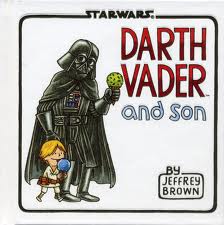
Darth Vader and Son
by Jeffrey Brown 
Chronicle Books, 2012
ages 7 and up

Hilarious cartoons imagine what life would have been like if the Dark Lord of the Sith had raised his future Jedi Master son himself. Charming everyday father/son moments are rendered uproariously silly when shared between these two characters.

Every father and son should have this book. But don't leave out the girls - daughters like it, too! This book is a perpetual favorite around the house.


Star Wars Origami
by Chris Alexander
Workman Publishing, 2012
ages 7 and up

It is exactly what it says - a fabulous how-to book for folding simple pieces of paper into fantastic movie memorabilia. This is the ultimate gift for fans of George Lucas and Tom Angleberger. My children were dying to get their hands on it while I looked it over. When I relinquished it to them, they eagerly started making light sabers and the death star.

The soft cover book contains instructions and decorative paper for creating thirty-six origami Star Wars characters and vehicles, and also includes games, movie trivia, quotes and stills. But the enjoyment never ends as long as there is a blank sheet of paper around. Favorite folds can be replicated time and again.


Be sure to read my other October 2012 posts featuring Tom Angleberger.

Interview with Tom Angleberger


I had the good fortune to meet Mr. Tom Angleberger on August 10, 2012, at bbgb tales for kids bookstore just before a signing for his latest book, The Secret of the Fortune Wookiee (Abrams, 2012).

 Mr. Angleberger began, “I haven’t got much to say, frankly. I’m mostly just about Star Wars and origami.

“You know, I jut met R2. At a bookstore in Cincinnati there’s a Star Wars expert there, and he’s an illustrator of a lot of the Star Wars books; anyway, he’s just made his own R2-D2. He brought it to the store. It’s amazing…

“That’s the great thing about my job, is that I’ve got side benefits of meeting R2-D2 and Chewbacca. …I came very close to meeting George Lucas, but he has a lot of stuff on his plate.”


MDC: Tom, your writing has a lot of energy. Do you find you have to work up into a certain mood? Perhaps you dress in character, or do calisthenics?

TA: I think for a long time before I sit down and start writing. I walk many, many miles in the process of writing books. So when I sit down to write, I usually know what’s going to happen and so the energy goes into picking the words and finding the little ways of putting the puzzle pieces together.

Your online bio lists Asperger’s syndrome as your superpower. Tell me about that.

My brain is not exactly wired properly and one of the side effects is the outpouring of words – there are other side effects, some of them unpleasant – but one of them is the outpouring of words, which can be unpleasant at the wrong time. But when I’m sitting in front of my computer and the words pour out into new chapters of Origami Yoda, at those moments it seems like that what’s my brain was supposed to be doing.

Do children with Asperger’s recognize something in your Origami Yoda books?

The great thing is that a lot of them are reading my book. Often when I have an event I look out and I see some fellow aspies out in the audience. We understand each other.

The crazy, crazy thing is the stuff that that only isolated me when I was in school - like being a big fan of Star wars - to the point of annoying everybody with how big a fan I was, and origami to the point where I was folding instead of whatever else you’re supposed to do at school - these two things which were maybe my weakness back then, now that’s what I’ve got to offer. And the crazy thing is when those two things came together instead of being weaknesses they turned into this huge thing that changed my life. Star Wars Origami, I mean has totally changed my life.

If you went back and asked the other people I was in the sixth grade with and you said, “Do you think what he’s doing now is going to turn out to be good?” you know, they’d be like, “No way, he’s gotta grow out of it!” And I didn’t.

Did your parents think the same way?

My parents have been incredibly supportive all the way along. They let me be an art major in college and they’re huge supporters of the books … They were very good parents for an aspie to have. They handled it all pretty well.

You have also been published under a pseudonym.

I have two books as Sam Riddleberger.

Is he an alter ego?

No, that was just the time I felt the need for a pen name. I was writing for the Roanoke Times, privacy issues and all of that, and I wanted a pen name and it was just a total disaster all the way around. Everybody hated the name. My grandmother was mad because I wasn’t using my real name. I’d walk into a school and they were like,  “Do we call you Sam, do we call you Tom; who are you?” It was all a big mess and so Sam Riddleberger probably won’t be writing any more books. He’s had his moment.

Let’s talk origami. What sparked your young interest?

When I was probably four or five my mother taught me how to make the origami cup. It’s very helpful when you need a cup and all you have is a piece of paper. But you made a cup and it works for a little while. So that was probably my first origami. And then Curious George folds all those newspapers into boats and he’s got the instructions for the boats right there in that book. And I had another book or two at that time that had origami and origami instructions in a fictional book. So that stuck with me and when this book came out, having Yoda instructions in the book just made perfect sense.

Do you get a lot of Yodas in the mail?

The way I like to get them best is by email because I post them up on origamiyoda.com. We have a thriving community of kids called super folders. They send in their stuff and I post it and they comment on it. That’s a huge thing and it has been one of the best parts of doing this. They’re great kids and I actually use a lot of their ideas in the book, so they really become a part of the writing of the books.

Anybody who reads this and wants to fold something, after you fold it email it to me and I’ll put it on origamiyoda.com

Like the original Star Wars, are your Origami Yoda stories a trilogy?

The Fortune Wookiee book sort of ends with a cliffhanger, so we’ve had to admit to people, yes, there is another book. But unfortunately it is still top secret who the star of that book is going to be.
Tom Angleberger tries on the Heidelberg Handlebar #7.

I enjoy all your books, but Horton Halfpott is my personal favorite. It is a really intelligent, really silly book. The narrator is a great character!

The narrator actually almost made an appearance in the book. The narrator was born when I was reading Charles Dickens. You know he [Dickens] can be really funny and I thought man, I would like to write a book the way he’s writing this. And I sat down to do it and I really thought it would be a book for adults. M’Lady Luggertuck was this elegant lady in this big castle and everything, and next thing I know, the kitchen boy shows up in the story and he just took over the story.

He was just such a great character, he took it over and that’s how that whole book happened, and that’s the reason I got started writing for kids was because that kitchen boy showed up and insisted that the book be silly and crazy and wacky. And unfortunately some adults refuse to read silly, crazy, wacky books – it’s a sad fact – but most kids are willing to read a silly, crazy, wacky book.

Might you write for adults at some point?

No. It’s going to be all for kids, and adults are welcome to read it if they are willing to take a chance on silly, crazy and wacky.

The characters’ names sound like their personalities – Old Crotty, Montgomery Crimcramper, Blight and Blemish – how did you come up with them?

That was part of just loving Charles Dickens and some of those other authors with the crazy names and so I would just sort of think for a second and whatever would pop into my head I would try to give it a Dickens twist and then run with it.

And you illustrated them…

That was actually probably the hardest thing I’ve ever done. Because the drawings in Origami Yoda are pretty easy to make. They’re fun doodles. But the drawings in Horton Halfpott, I wanted them to be really good! And I’m not all that good so I worked all summer just pounding away and drawing those over and over. Plus they were done in pen and ink, so that’s a crazy mess. That was a lot of fun.

Tell me your favorite: Summer or Winter Olympics?
I’m going to have to say X Games.

Partridge Family or Brady Bunch?
Brady Bunch

Adam West or Christian Bale?
Oh, Adam West!

Hardy Boys or Encyclopedia Brown?
Three Investigators

Narnia or Middle-Earth?
Middle-Earth

Paper or plastic?
Paper. You knew I was going to say paper. That was a set-up.


Be sure to read about the book signing in my other October 2012 post featuring Tom Angleberger. 

And two more great Star Wars books!