Pages

Showing posts with label for teens. Show all posts

Tuesday, January 1, 2013

Cozy Up With A Classic


Histories and classics are sometimes forgotten by the young reader because he has so many choices at the library. Often it is the newest releases that are prominently displayed and thus garner the most attention. The books suggested here are a nice combination of history, classic story and innovation. Perhaps one will end up in your hands.


Cozy Classics: Pride and Prejudice
by Jack and Holman Wang
Simply Read Books, 2012

I loved this book before I even opened it. The idea – making a board book out of Jane Austen’s most treasured novel – is just too delicious for words. And the cover! Look at dear Elizabeth Bennet protecting her bonnet from the wind and tugging at her muddy skirts. Priceless.

Brothers Jack and Holman Wang condensed Pride and Prejudice down to twelve toddler-friendly words. Then they created and photographed sculptured dolls to illustrate the simplified story. The Wang brothers make the dolls by needle felting: using a barbed needle to tangle and compact wool fibers, forming three-dimensional felt sculptures. They are remarkably lively and absolutely beautiful.

Cozy Classics: Pride and Prejudice is the result. The first spread displays the word “friends” and we see Mr. Bingley smiling, his hand on the shoulder of Mr. Darcy. They are standing in front of the first page of the novel where we can just make out that oh-so famous opening line, “It is a truth universally acknowledged…” Delightful!

Cozy Classics: Pride and Prejudice is a must-read for moms who love Austen. Also available is “Cozy Classic: Moby Dick,” and coming this spring, parents can enjoy sharing a cozy version of Victor Hugo’s “Les Miserables” and Leo Tolstoy’s “War and Peace” with their very young children.


Magic Tree House #47: Abe Lincoln At Last!
by Mary Pope Osborne
Random House, 2011

Beginning and middle readers may be interested by the extensive promotion of Spielberg’s movie “Lincoln.” Though they are too young to see the film, children can get in on the history by reading Mary Pope Osborne’s Magic Tree House #47 Abe Lincoln at Last! Osborne guides readers on a journey of the imagination to Washington, D.C. in the year 1861 to give the president a message of hope.

Osborne’s tremendous Tree House series is beloved by so many because its main characters, Jack and Annie, are smart, funny kids who are sent on some pretty unbelievable adventures to visit places where real history happened.

That special blend of fiction and fact often inspires a thirst for more information about a featured topic, so the folks from the Tree House series created nonfiction supplements. In this case, the Magic Tree House Fact Tracker: Abraham Lincoln is a resource with information about life in a log cabin, what a blab school was like, and what headlines were in the newspapers in 1837. Did you know that Lincoln held a patent for an invention that would make boats lighter whenever they got stuck? Me neither.


Jane
by April Lindner
Poppy, 2011

For your teenager who was obliged to read Charlotte Bronte’s Jane Eyre at school and actually sort of liked it, there is a fun reimagining of that classic in April Lindner’s novel, Jane.  

Lindner modernizes the tale by wondering what would happen if a Jane Eyre were to fall in love with a rock star. Her character Jane Moore is the new nanny at Thornfield Park, home to world-famous rock musician Nico Rathburn. Fans of the classic novel will enjoy how Lindner is able to pay homage to the original while telling an emotional and engagingly modern story. It’s a great romance. The book is entertaining even to those who have never heard of Bronte.

I thoroughly enjoyed this book, with one caveat: Jane Moore has a physically intimate encounter with Nico just before she flees Thornfield Park. I have to say that I was disappointed. Lindner’s main characters are so evocative of Eyre and Rochester that I felt truly let down that Rathburn wasn’t willing, for Jane’s sake, to keep from going too far. Sex may be part of the protocol in modern romances, but here it is dissonance.


CLASSIC CHOICE

Probably the most classical you can get, story-wise, is to read Homer’s Iliad and Odyssey – epic poems of heroism and hubris that have been translated and retold by many. If you are looking for a nice translation to read to your family, consider one of these:


The Adventures of Odysseus and The Tale of Troy: Homer’s Great Epics, Rewritten for Children, by Padraic Colum (1918) – The high style is difficult for a grammar school child to read alone, but perfect for reading aloud to him as a child’s listening comprehension level is often quit a bit above his reading level.  


Black Ships Before Troy: The Story of The Iliad, by Rosemary Sutcliff (Frances Lincoln, 2005) - A lyrical, emotional retelling of the epic poem that should keep readers ages 8 and up enthralled.


The Adventures of Ulysses, by Bernard Evslin (Scholastic, 1969) – I use this retelling of the Odyssey when teaching eighth and ninth grade English. Short chapters and lots of action made it a quick, pleasurable read.


Mythology: Timeless Tales of Gods and Heroes, by Edith Hamilton (Little, Brown & Company, 1942) - A perennial bestselling collection of Greek, Roman and Norse myths that is the classic introduction to mythology for teen readers.


Michelle Clark would like to throw out the TV so there would be more time for reading classic literature, but then she might miss an episode of Downton Abbey.   

Saturday, September 1, 2012

Back-to-School Stories


I absolutely love school stories. I always have. As a child, I had favorites that I read repeatedly, never growing tired of them. Perhaps that’s why I became a teacher.

As I write this, the office supply stores are all abuzz with the excitement of the back-to-school season. Their stacks of gloriously untouched post-its and markers beckon. The smooth surfaces of neoteric notebooks and the woody smell of freshly sharpened pencils take me back to my favorite stories….


Perhaps the greatest book ever written for children who are just beginning their school careers, Richard Scarry’s Great Big Schoolhouse (Sterling, 2008) follows Huckle Cat into Miss Honey’s happy classroom to learn the alphabet with Lowly Worm and all their friends. Filled with Scarry’s delightful illustrations of school scenes labeled with pertinent vocabulary, this book begs to be stared at for long periods of time. If you’re a purist like me, you’ll want to find a used copy of the 1969 original. I will never understand why publishers abridge classics. In this case, the abridged version will do, but it will not be exactly what you remember from your childhood.


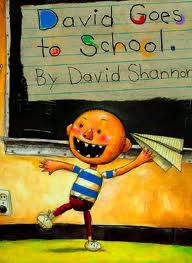
Author and illustrator David Shannon became an instant favorite in my family with his book, No, David! (The Blue Sky Press, 1998). So when I looked for more Shannon books, David Goes to School (1999) was gleefully added to our family library. David’s naughty behavior is funny to readers, but not to David’s teacher. Childishly stylized drawings in bright colors highlight David’s lovable but messy personality.  Trouble seems to find him at every turn, but David redeems himself and earns a gold star.


Chrysanthemum by Kevin Henkes (Greenwillow Books, 1991) is the story of the little mouse who treasures her absolutely perfect name until she begins kindergarten and finds that innocence sometimes takes a beating at school. I love the joyful, rhythmic quality of the text as Chrysanthemum relishes her name. I love the sweet, narrative illustrations. I love the happy ending and the epilogue wherein everyone gets her just desserts. Chrysanthemum, Chrysanthemum, Chrysanthemum!


It’s never too early to acquaint your family with Laura Ingalls Wilder’s collection of Little House books. Each is a joy to read, but I am especially fond of Little Town on the Prairie (HarperCollins, 2008). Time and again I have read this book, skipping over the first ten chapters so that I can begin with Laura on her first day of the school year with Miss Wilder as her teacher. Oh how I love to hate that Miss Wilder and her unfair treatment of Laura and her sister. Oh how gleefully I cheer for Laura as she makes her desk go thump, THUMP!


Addy Learns A Lesson: A School Story, by Connie Porter (Pleasant Company, 1993) is the second book in a series of six about Addy, the Civil War era doll in The American Girls Collection. Addy Walker’s family were slaves on a plantation in North Carolina and she and her mother have traveled to Philadelphia to begin life as free people. Addy goes to school where she learns to read and write. Also, she must make a difficult choice when it comes to finding a true friend.

The fright of starting something new, the hard work that sometimes ends in discouragement, the yearning to be accepted by a certain group – all of these things are familiar to young readers. Putting them against the backdrop of 1864 America makes the story particularly inspiring, and the Peek Into the Past at the end of the book offers a nice historical perspective.

I think very highly of the American Girls Collection of historical fiction and I recommend them to daughters everywhere.


There are 17 books in the terrific series, Hank Zipzer: The World’s Greatest Underachiever by Henry Winkler and Lin Oliver (Grosset & Dunlap), about a smart fourth-grader dealing with dyslexia. Hank is creative and funny but he struggles a lot with schoolwork. Luckily he has two great friends, a family that loves him and one teacher who takes the time to find out why Hank is sinking at school. Winkler and Oliver relay the wacky exploits of unsinkable Hank with humor and sensitivity. Hank is a lot like some of the students I have known over the years, and it is nice to get to know him better with each book.


I adore Renee Goscinny’s witty book Nicholas (Phaidon, 2005), the first in a series of books first published in French in 1960. Nicholas is a schoolboy whose cherubic sincerity is gleefully incongruous with the chaos that swarms around him and his chums.

Told from Nicholas’ naive point of view, this account of recess, classroom antics and play dates makes use of run-on sentences to capture his breathlessly fast-paced thoughts. Nicholas is rather like Bill Watterson’s Calvin, though far less calculating. On Nicholas' report card the teacher writes, “A rowdy and often inattentive pupil, given to fighting with his friends. Could do better.”

Each chapter is its own complete episode, so I often grab this book from the shelf and let it fall open where it may.

Whimsically illustrated in pen and ink by Jean-Jaque Sempe, this book is a delightfully droll romp through school.


Roald Dahl’s memories of his school days are collected in the fascinating book, BOY (Penguin, 1984). It is the first biography to make me see the joy in reading biographies. If you are fond of Dahl’s fiction, you will savor this look at life in an English boarding school in 1925. His recollections range from faking appendicitis to warming a lavatory seat for an upperclassman. About this book Dahl wrote, “None of these things is important, but each of them made such a tremendous impression on me that I have never been able to get them out of my mind… Some are funny. Some are painful. Some are unpleasant … All are true.”


Michelle Clark shares Roald Dahl’s passion for the Ticonderoga #2 pencil.  Tell her your favorite school stories at mail@richmondpublishing.com

Wednesday, August 1, 2012

Goodbye to Sumer Reading


Summer is almost over. Soon it will be time for all good little children to return to their textbooks and assigned reading. But before you give up on all things light and warm, pick up some of these graphic novels for extended summer reading pleasure.

The Flying Beaver Brothers and the Evil Penguin Plan
by Maxwell Eaton III
Alfred A. Knopf, 2012
ages 6 - 10

Meet Ace and Bub, beavers who are brothers who sometimes fly. Ace loves extreme sports and is always looking for a new adventure; Bub loves napping and, well, napping. But when Arctic penguins in their giant underwater refrigerator plot to freeze Beaver Island for “resort and polar-style living,” the brothers must save the island and win the surfing competition.

The two-color graphics are easy to follow and much of the droll humor is found in the contradiction between the text and illustrations. If your child likes it, you’ll want to grab the beaver brothers second adventure, The Flying Beaver Brothers and the Fishy Business (Knopf 2012), in which the brothers must expose the Fish Stix Environmental Manufacturing plant for what it really is – a giant pencil sharpener. Will Ace and Bub and their penguin cohorts Bob and Bob be able to make enough pancakes to save the forest from destruction?


Giants Beware
by Rafael Rosado and Jorge Aguirre
First Second, 2012
ages 7 - 12

An outspoken, red-haired daredevil called Claudette tricks her meek younger brother and her fussy best friend into joining her on a quest to slay a giant. Together, the three youngsters must overcome man-eating trees, the Apple Hag and the Mad River King to arrive at Giant’s Peak where they will meet the towering Minu. In the end, the timid little bother proves his mettle, the aspiring princess finds that diplomacy is her new calling, and the intrepid Claudette learns that friends are better than fame.

With large, colorful panels and snappy dialogue, this rip-roaring adventure is easy to read and lots of fun. There are many secondary characters whose mysterious backgrounds are barely touched on in the story, so here’s hoping that further adventures are in the works.


Vordak the Incomprehensible: How to Grow Up and Rule the World
by Vordak T. Incomprehensible; notes transcribed by Scott Seegert
Egmont, 2010
ages 8 and up

Packed with snarky humor, this book contains Vordak’s sixteen Commandments of Incomprehensibility that will help you, a random doofus, to RULE THE WORLD!  With vocabulatory superiority, the grandstanding evil supergenius fills his how-to book with all sorts of useful information about everything from choosing your gut-wrenchingly evil name and costume to upgrading your evil lair. Vordak’s guide is filled with delicious babble, fun font changes, wacky drawings and thinly veiled umbrage. MUAHAHAHAHA!!!

Can’t get enough? Why then, pick up Vordak’s second book, Vordak the Incomprehensible: Rule the School (Egmont, 2011) in which our bombastic super villain mistakenly shrinks himself and must pretend to be a student at Farding Middle School (say that out loud), home of the Farding Ferret. Great fun!


Friends With Boys
by Faith Erin Hicks
First Second, 2012
ages 12 and up

Being homeschooled and raised with three older brothers has its ups and downs, but Maggie’s life gets a lot more complicated when she begins her first year of high school. She has to navigate the school corridors and puzzle through the complex relationships of the people who roam there, plus there’s the small matter of being haunted by a ghost who won’t leave her alone.

A great coming-of-age story from a truly talented artist and writer, this graphic novel is a gem. Hicks’ pen and ink drawings capture the tangled emotions of her characters through their facial expressions and body language. Much of the story is told in their silences.

The ghost part of the plot may seem a little weird, but it offers an unusual way for Maggie to learn that she can’t fix everything in her life - some shadows may hang over her and that’s okay. The ghost manages to give the story a bit of an edge without distracting from the believable plot and sympathetic characters Hicks has created.


CLASSIC CHOICE


Magic Tree House, the award-winning children’s series that is widely regarded among teachers and parents alike for its power to instill a passion for reading, celebrates its 20th anniversary this year. Written by Mary Pope Osborne, the popular series describes the adventures of siblings Jack and Annie as they travel around the globe and across time, solving riddles, cracking codes and helping those in need.

Osborne’s books are great as a read-aloud and are enticing for young readers to tackle on their own. Each story contains the key ingredients of danger, suspense, humor and a little sibling rivalry. They also introduce readers to different cultures and times in history.

Alongside these outstanding works of fiction, the people at Magic Tree House have created Fact Trackers – nonfiction companions to the Magic Tree House books that give readers more information about the historical events and places visited by Jack and Annie. Are your children interested in the Olympics? Show them Magic Tree House Fact Tracker #10: Ancient Greece and the Olympics.

And waiting now on bookstore shelves is the newest book, Magic Tree House #48: A Perfect Time For Pandas. It is sure to please Tree House fans.


The Clark children eagerly began reading independently with the Magic Tree House series. Get more reading ideas at clarkbookmark.blogspot.com/

Friday, June 1, 2012

Monarch Mix-up

Why not try a little royal reading with your children this month? Noble stories of kings and princesses abound for all ages. From the Brothers Grimm and Hans Christian Anderson all the way up to modern day authors, everyone loves an aristocratic tale.

The False Prince by Jennifer A. Nielsen (Scholastic, 2012) is an exciting new book for readers ages 12 and up. It is the story of an orphan called Sage who becomes an unwilling participant in a plot to usurp the throne of Carthya.

Sage is an arrogant, street-wise young man who has become a liar and a thief in order to survive his four-year residence at Mrs. Turbeldy’s Orphanage for Disadvantaged Boys. Against his will, Sage becomes the property of Bevin Conner - a formidable man, plotting to rule the kingdom by training a boy to impersonate the prince who was lost at sea and presumed dead. Conner forces Sage and three other orphans to compete for the role of princely imposter. The winner will become king. The losers must die.

The high level of tension among the characters makes this a gripping story. Nielsen has a brassy, imprudent character in Sage, yet he is also valiant, honorable and ferociously his own man. Sage never goes back on his word and he will not acquiesce to the terms set by Conner. These traits will likely cost him his life.

“You should always choose on the side of hope,” Sage advises another character, though his own situation appears to be utterly hopeless.

Sage is under attack from Conner’s henchmen and the competing orphans, and he is fighting his own demons. As the kingdom of Carthya teeters on the brink of civil war, Sage can survive only by coming to grips with a secret past.

This book is the first volume of the fledgling Ascendance Trilogy. Book two will be released in 2013. 


Another story of about a royal mix-up, for readers ages 12 and up, is The False Princess by Eilis O’Neal (Egmont, 2011). Upon her sixteenth birthday, Princess Nalia is informed that her whole life has been a sham. She is not the princess, but an orphaned peasant named Sinda: a stand-in for the real Nalia, who was hidden away when the oracle prophesied that her life was in jeopardy. Now that the danger appears to have passed, the real Nalia will assume her proper place at the castle and Sinda is sent back to the vulgar life she was truly born into.

This devastating turn of events leaves a shocked Sinda at the mercy of her cold aunt who lives in a distant village. Sinda does her best to accept her new station and to be useful to her aunt, but she is completely unprepared for such an existence.

When dormant magical abilities begin to surface within her, Sinda seeks training from a wizard. The mystery surrounding the long-ago prophecy deepens and Sinda uncovers a secret about the true identity of the princess that no one could have imagined.

Though rather inelegant in style, this story is still a nice bit of entertainment. Sinda’s demotion from princess to pauper is a nice twist on the typical switched-at-birth plot. There’s a little adventure, a little romance and a little magic. This is not a gripping page-turner, but light fantasy fare that will be enjoyed, but not long remembered.


CLASSIC CHOICE


The Prince and the Pauper by Mark Twain  (1882)

A classic tale of mistaken identity and royal confusion, The Prince and the Pauper will introduce children to an important and entertaining American author.

Mark Twain summarized this novel succinctly in his autobiography: "Edward VI and a little pauper exchange places by accident a day or so before Henry VIII's death. The prince wanders in rags and hardships and the pauper suffers the (to him) horrible miseries of princedom, up to the moment of crowning in Westminster Abbey, when proof is brought and the mistake rectified."

Of course the actual story is so much more than that, and Twain writes with his typical flair for humor. Mark Twain is celebrated for his superb talent for capturing the dialect and peculiarities of a place or period.

Twain’s novels are wonderful to read aloud. Reading with your child will eliminate the intimidation factor brought on by many pages, archaic language and the worry of, “Oh, that book is old!” 


M.D. Clark was blessed with a father and teachers who read aloud to her right up through high school.

Interview with Jennifer A. Nielsen


photo credit: Jeff Nielsen
Jennifer A. Nielsen, author of The Underworld Chronicles, talked with me about her current series, the Ascendance Trilogy, which begins with her recent novel, The False Prince.


MDC: This is a gritty, engrossing story! Sage is an intense character and you seem to know him so completely – where did he come from?

JAN: Sage came from the line of an Eddie Vedder song, “Guaranteed,” in which he wrote, “I knew all the rules, but the rules did not know me, guaranteed.” I loved that line – the idea of a character who could know everything about the game he is playing, but who would be secretly changing all the rules of play.

Once I had that line, I had Sage, all of him. So Book 1 wasn’t about me creating Sage as much as it was discovering him. As intense as he is on paper, he’s just as strong in my head. He lives there as this voice constantly informing me of his opinions, or directing whatever scene I’m trying to write next.


Are Sage’s headstrong ways fearless and admirable, or is he just plain foolish?

Both are correct, I suppose. To me, Sage is a study in contrasts. He is brave, but also experiences fear for his situation. He makes a lot of jokes, but takes on the world with great seriousness. He can mock, but also demonstrates sincere compassion for those around him. And no matter what trouble he dives into, he is very clear that he doesn’t like pain.

I think where the foolishness comes in is that Sage will never move backward. Whether it’s a strength or a flaw, he doesn’t know how to do anything but push ahead. Sometimes that works out for him, and sometimes it’s just plain foolishness. But it’s all he knows.


Each character has a different motive for cooperating in the plot to overthrow the royal family.  Readers may look at Conner and wonder if there is any nobility in his quest to save the kingdom. He claims to be selfless in his actions …

It’s what I love about Conner. He’s so interesting to me because from his perspective, he’s truly doing the right thing. If Conner were writing this story, he would be the hero. He’s not trying to be a saint, and there’s definitely something in it for him, but he wouldn’t consider himself a villain either.


…  bringing up the eternal question: Do the ends justify the means?

Hmm, this will reveal me to be a nerd of unparalleled status, but someday I’d love to write an entire essay solely dedicated to Conner. Not only his personal moral code (or lack thereof), and the way Conner compares and contrasts to Sage, but an evaluation of this very issue as it applies to THE FALSE PRINCE. Because that question leads to the very gray moral area where Conner lives his life, and it would be fun to explore.


You have said of your writing: it “came to me,” and, the “story tumbled out of me.” Tell me more about what that is like.

The idea for this book was with me for a long time, like standing in a slowly filling pool of water. But finding Sage was like having a wave crash into me. All at once, everything was there, as if he brought the details of the story with him and my job was simply to get it down on paper. I’d be writing a scene where Sage is inevitably getting into trouble, and I’d be hoping he decided to back down because I knew what was coming next if he didn’t. Of course, he never did, and then I’d just cringe as I turned the page for the next scene. Writing this book was like watching the movie in my head, and just trying to type fast enough to keep up with it.


Chapters 42 and 43 bring about a great shift in the story and still they don’t give it all away. Did you have a hard time putting clues to the plot twist throughout the story without giving away too much?

I hope that readers who are surprised by the turns in the plot will enjoy going back through the pages to look at the story with new eyes. And that readers who anticipated some of the ending still enjoy the journey. Either way, if the readers feel they’ve been on a great adventure with Sage, then I’m happy!


This book is quite satisfying by itself, but it is really the opening for a three volume series: The Ascendance Trilogy. When can readers expect the next installment? Can you give any details?

The second book in the series should be released next spring. I hope readers will find it to be just as big an adventure as Book 1. And while I’m not allowed to say much about it, I can tell you that for Sage, things definitely get worse!


Though we only get a glimpse of her, I like Princess Amarinda - she’s very practical, and a bit morose. Will we see more of her in the trilogy?

I like Amarinda too. I think she’s in an extremely tough position in this story and I enjoy watching her navigate her challenges while maintaining her dignity as a princess. There are several characters that you’ll see more of as the trilogy continues, and I hope you’ll enjoy seeing where the unfolding story takes all of them.


Are you a Jack London fan by any chance? The battle to break Sage's will reminded me so much of The Call of the Wild.

Okay, confession time. I’ve never read The Call of the Wild – and in fact, I’ve actively avoided reading it for my entire life. As a child, I had a really hard time with stories where the beloved dog gets hurt. As an adult, I could probably handle it now, but the dread of reading animal stories remains with me. Maybe one day I’ll get there, if only because now I’m curious to read the story with the comparison of Sage in mind.

Thank you, Jennifer, and best wishes for your writing career.

Thank you very much for a fun interview!

Thursday, March 1, 2012

Greek Mythology: George O'Connor's Olympians; Tracy Barrett's King of Ithaka

Authors such as George O’Connor and Tracy Barrett are looking back to the original sources of ancient myth to create fantastic retellings of legendary tales. Their books are great reading for teens who are already familiar with and fond of Greek mythology.

George O’Connor has created the exciting Olympians series of graphic novels.  His four books, Zeus - King of the Gods, Athena - Grey-eyed Goddess, The Glory of Hera, and Hades - Lord of the Dead, published by First Second, are spirited, well-researched interpretations of classic Greek myths in comic book form.

Zeus - King of the Gods tells the creation story in which the titans and the gods battle for supremacy. O’Connor’s illustrations convey the power and intensity of this epic clash, and his narrative gives the gods flesh and bone as they struggle like superheroes and tease like siblings.

“When I was researching Olympians, not just reading the ancient sources, but also traveling around Greece and Italy and other places where people had worshiped the gods, I began to get a much different version of how the gods should be depicted and perceived,” O’Connor said in an interview with Chris Mautner of The Comics Journal. “As I added my own twists here and there, I made connections that were not so apparent before and condensed a couple of characters into one, all in the interest of creating a whole tapestry of Greek mythology.”

All four volumes of O’Connor’s mighty tapestry are freshly appealing to young adult readers. His panels reverberate with passion and fury. O’Connor handles the wanton nature of his characters with delicacy so that alert parents  have nothing to fear. At the back of each book, the author’s note is like a mini conversation with O’Connor, and the bibliography and geek notes offer a wonderful opportunity for further learning.

This series gets my bookmark because it is intelligent, action-packed and a lot of fun. I’m looking forward to future volumes in the series and am hoping that O’Connor makes good on his proposal for a spin-off series of heroes and monsters.

***
Tracy Barrett is a professor at Vanderbilt University and has authored a number of books for young adult readers including Anna of Byzantium, and The Sherlock Files mysteries.  Barrett’s recent novels seek to recreate the ancient world while adding a new dimension to familiar characters from mythology.

King of Ithaka (Henry Holt, 2010) is Barrett’s imaginative exploration of the personality of Telemachos, son of Odysseus.  Accompanied by his friends Brax and Polydora, Telemachos must go in search of his father and then "return to the place that is not, on the day that is not, bearing the thing that is not.” The struggles ensuing from this strange quest help Telemachos grow in the knowledge of what it takes to be a king.

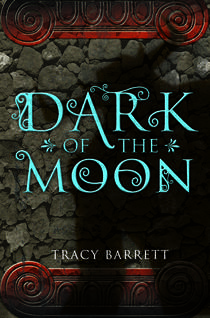
Barrett’s most recent novel is Dark of the Moon (Harcourt, 2011), a very clever re-imagining of the myth of Theseus and the Minotaur. The story is told mostly from the point of view of Ariadne, a young woman about to become the moon goddess of Krete. Ariadne’s misshapen brother Asterion is the captive Minotaur monster to whom Theseus will be sacrificed.

Barrett writes characters that must face the mundane challenges of daily living with as much courage as is required for the more heroic contests of legend. This quality lends a sense of credibility and even modernity to the story. When I asked her about this, she explained:

I don’t think it’s true that people are people; that we’re all the same no matter where or when we live. If that were the case, there would be no such science as anthropology or sociology! But I do believe there are some constants. At the beginning of “King of Ithaka,” for example, Penelope has to find Telemachos’ shoes for him. Ask any mother of a teenager, and she’ll tell you that boys have shoe-blindness. I bet that was true in the Iron Age as well! I also think that teenagers have always and will always flirt, feel caught between childhood and adulthood, be easily embarrassed, simultaneously crave and fear adventure. I really enjoy exploring these familiar emotions in an unfamiliar setting.

When I asked why students should read the classics, Barrett replied:

The most important reason is that the classics are wonderful stories. They wouldn’t have come down to us if they weren’t. For any ancient tale to have survived is miraculous—someone had to love it enough to write it down (both the Iliad and the Odyssey were originally told orally), and then it had to be copied over and over again in order to survive thousands of years. Paper and parchment were expensive, so they were reused and repurposed if what was written on them wasn’t considered important enough to save (some important ancient writings were reused as mummy wrappings in Egypt!). If a book wasn’t loved and taken care of, it would rot or fall apart or be eaten by bugs. So lots of people had to have loved these stories in order for them to make it to the twenty-first century. They can’t all be mistaken.

Tracy Barrett had a lot more to say about studying the classics, her writing, and these stories. I thoroughly enjoyed our conversation and I learned a lot. Please read the full interview on my March 2012 blog post. 


M.D. Clark reads Greek, Norse and Irish myths to her children. 

An Interview with Tracy Barrett


Tracy Barrett is the author of a number of books for young adult readers including Anna of Byzantium and The Sherlock Files mysteries. She talked with me about her two most recent novels, Dark of the Moon and King of Ithaka.  


MDC: Current literary trend seems to be to take the gods and monsters of myth and put them in the modern world. Your approach is different …

TB: Yes, I enjoy reading those books but I prefer trying to re-create the ancient world!

 … and in a way, your stories have a kind of “modern” feel. Can you explain?

I don’t think it’s true that people are people; that we’re all the same no matter where or when we live. If that were the case, there would be no such science as anthropology or sociology! But I do believe there are some constants. At the beginning of King of Ithaka, for example, Penelope has to find Telemachos’s shoes for him. Ask any mother of a teenager, and she’ll tell you that boys have shoe-blindness. I bet that was true in the Iron Age as well! I also think that teenagers have always and will always flirt, feel caught between childhood and adulthood, be easily embarrassed, simultaneously crave and fear adventure. I really enjoy exploring these familiar emotions in an unfamiliar setting.

The spelling of some words may be different than the reader is used to (for example: Aegyptian, qat, kyklops). Why?

The spellings usually used in English are latinized versions of Greek names/words. For example, Greek didn’t have the letter “c” and Latin didn’t have “k,” so the Greek “Kyklops” became “Cyclops” in Latin. Many masculine nouns in Greek end in “-os” but in “-us” in Latin. English adopted the Latin spelling, but Latin wasn’t a major language for quite a while after the time when my story takes place, so I used something closer to the original Greek—I didn’t see why I should use Latin spelling just because the Romans didn’t feel like using “k” or “-os”!

I wasn’t 100% consistent, though. In some cases I kept a more familiar spelling so that my reader would know what I was talking about. I didn’t think they would recognize the Sirens if I called them Seirenes, the more accurate rendering of the Greek word!

“Aegyptian” and “qat” are a bit different. I used an antiquated spelling of “Egypt” and a spelling of the word that “cat” might possibly derive from. Both Egypt and cats are very familiar to my readers—I hoped that by using an unfamiliar spelling I would show how exotic they were to Telemachos.


Telemachos is afraid of the sea, not adept at lighting fires – he’s a bit unexpected for the son of Odysseus. What were your thoughts about his childhood?

I think that both Telemachos and Penelopeia have a lot of fears that govern large parts of their lives. Telemachos knows that his father sailed away and never returned; therefore, the sea naturally holds a lot of terror for him. He also doesn’t have any kind of role model; his grandfather is old and befuddled, and most of his neighbors are greedy and lazy. Somewhere inside of him he knows that he really needs to man up, but he’s so afraid of growing up (and also, he has a pretty cushy life) that he closes his eyes to the abuses going on in his home.

Penelopeia also doesn’t want him to grow up. It’s easier to spoil him, not make him work, and indulge him, than to allow him to face the suitors and perhaps lose his life by challenging them.


From what I remember of Homer, Odysseus is manly and gentle when not battling. Your Odysseus is quite different. Tell me more about him.

One of the main points I’m trying to make in King of Ithaka is that poets/novelists/singers/painters/journalists have a huge role in how we think of people and events. Homeros has to flatter his patron and praise all the major players on the Greek side in the Trojan War. Of course he would show Odysseus in a positive light—he’d lose his job as court poet if he didn’t.

But Homer is a very subtle poet. If you read the Odyssey with an open mind, trying to forget the movies and other places you’ve seen him, Odysseus starts looking like a jerk. Dante had it right—Odysseus lies and lies. Sometimes he lies to save his skin, but sometimes it looks like it’s just for the heck of it. Plus, he had a lot of opportunities to go home that he didn’t take advantage of. If he was so eager to return to Ithaca and his family, why did he hang out with Calypso for seven years without making any attempt to escape? Why did he stay with Circe for a whole year, instead of sailing off immediately after he made her turn his sailors from pigs back into men?


The conclusion of the story is fascinating – unexpected and yet, inevitable. Did any of it come from Homer, or did you follow your imagination?

 I was really stuck about that for a long time. I fully intended to end King of Ithaka with the slaughter of suitors, as Homer told it. But when I got there, I knew that the Telemachos that I had written just could not participate in such a thing. So I changed it in a way that I hope is true to my character and to my story.

And as for what happened to Odysseus, there are actually three different versions of his life post-return to Ithaca (Homer wasn’t the only one who told his story—I’m just the most recent in a long line of re-tellers):
  • Odysseus ruled in Ithaca until the end of his days
  • being sick of the sea, he walked inland until someone didn’t recognize the oar over his shoulder and asked, “What are you doing with that winnowing-fan?”
  • he sailed through the Straits of Gibraltar and never returned
The last version is the one adopted by Dante, who shows Odysseus in the Circle of Liars in Hell, in his Divine Comedy. Speaking from inside the flame that burns him for eternity, Odysseus tells Dante and Virgil that he convinced his sailors to sail with him through the Straits of Gibraltar in search of adventure (the ancients thought that the Pillars of Hercules were a signpost that you shouldn’t go any further west than Spain). Odysseus uses every rhetorical trick in the book to convince his sailors to do this forbidden thing—his speech is a masterpiece of how to use words to manipulate people to do wrong. I paraphrased that speech in King of Ithaka!


In Dark of the Moon, the first person narration alternates between Ariadne and Theseus. Why did you choose to write Ariadne’s narration in the past tense and Theseus in the present?

First, I needed to differentiate their voices. I wanted a reader to be able to open the book at random and know which one was speaking. (Change of tense was only one way I did this—look at their sections and see which one is confused and asks a lot of internal questions and which one never does—not even once!) Second, Ariadne is rooted in the past. Her religion and her tradition have not changed in millennia. It’s logical that she would think in the past. Theseus is a man of the now. He doesn’t have much of a past—never even knew who his father was until shortly before the main action of the book—and he doesn’t think he has a future. The present tense was natural for him.


The mercy killing of Asterion calls to mind that decisive scene in Steinbeck’s Of Mice and Men. Had you planned it early on, or did it unfold as the story ran its course?

I knew that Theseus had to kill Asterion, but I also knew from the beginning that I wanted the motivation for the killing to change from mere survival, as in the myth. I wasn’t sure if the it was going to be self-defense or a mercy killing, so I had to wait until I got into the book and knew the characters better before I decided. The mercy killing seemed more natural.


The presence of the gods in your stories is very subtle, unlike the interfering sort we are used to. Tell me why.

Most ancient Greeks believed that although the gods could and did interfere in human endeavors, they weren’t interested enough in people to do so very often (they’re often portrayed as essentially lazy and self-absorbed). They participated in wars and great political events, that kind of thing—and if a particularly attractive human being caught their eye, they might make a play for them! But they weren’t terribly concerned with our day-to-day activities. The gods in my books are the same way.

In King of Ithaka, I also made sure that it was never crystal-clear that it was actually a god that Telemachos was talking to. It could have been an over-active imagination, a dream, wishful thinking.

I did make centaurs, satyrs, etc. a part of everyday life, however. This is because when I decided that Telemachos needed a best friend, he kept popping into my mind as a centaur. I told myself, “No! You’re not writing fantasy!” and turned him back into a boy, and he kept turning back into a centaur. So I finally said, “Fine, he’s a centaur.”


Why should students study the classics?

The most important reason is that the classics are wonderful stories. They wouldn’t have come down to us if they weren’t. For any ancient tale to have survived is miraculous—someone had to love it enough to write it down (both the Iliad and the Odyssey were originally told orally), and then it had to be copied over and over again in order to survive thousands of years. Paper and parchment were expensive, so they were reused and repurposed if what was written on them wasn’t considered important enough to save (some important ancient writings were reused as mummy wrappings in Egypt!). If a book wasn’t loved and taken care of, it would rot or fall apart or be eaten by bugs. So lots of people had to have loved these stories in order for them to make it to the twenty-first century. They can’t all be mistaken.

Also, we get a window into our own history. We often think of people of the past as being monolithic. We say “the ancient Greeks believed X” or “in the Middle Ages, everyone thought Y” as though they all had one mind, one set of beliefs. It’s wonderful to see how refreshingly individual they are, to see the humor, the drama, the love stories that are as real to us today, despite differences in culture, as they were to the people who wrote them.

There’s an educational reason too, although I hesitate to bring it up, because that makes the classics sound like medicine—something that’s unpleasant but that you should put up with, because it’s good for you. But there are so many references to the Greeks, the Romans, people from medieval history, the Renaissance in movies, books, comic books, paintings, that you get a whole new layers in them if you recognize the references. Read the Iliad and then watch Star Wars—you’ll be amazed at how much similarity you’ll see and how much the story is enriched for you.


Do you think there is any danger of mythology causing confusion for children brought up in a particular religious faith?

If a child is brought up in such a bubble that he or she is unaware that not everybody has the same beliefs as his or her family, that child is headed for a lot more confusion than my book could ever provide! Parents should have enough confidence in the way they raise their children that they shouldn’t be afraid that all those years of careful nurturing and education will be overturned by a book—or by ten books. Books are powerful, of course, but a parent’s loving teaching is much more powerful.


Do you have a favorite myth?

Just one??? I don’t think I can narrow it down that far! The one that’s most on my mind these days is the story of the Minotaur, since I recently wrote Dark of the Moon, which is a retelling of that story. 


I am always curious about how people write. Do you begin at the beginning and go from there? Do you first know where you want to end up and then figure out how to get there? Is your writing process different when retelling a familiar story?

I start from the beginning and work my way through. I always have at least a vague idea of how it will end, but lots of things change as I go.

I often go back as I write, and change events or strengthen or weaken a character’s personality once I know her or him better. For example, in my current work in progress, I started off thinking that my narrator, who has lost everyone dear to her, is motivated by wanting to be loved. I’m realizing now that it’s just as important for her to have someone to whom she can give love, and I’m finding places earlier in the manuscript to make that clear.

I also sometimes write an episode or scene as it occurs to me, and save it in an “idea file.” I don’t always use those ideas, but I often do.


Are you writing anything now?

I’m always writing something! Right now I’m in the middle of the first draft of a novel about an Etruscan slave girl who is brought to the city of Pompeii just before the eruption of Mt. Vesuvius. I also have another myth re-telling in mind but I’m forcing myself not to start it or even think about it too much until I finish the Pompeii story.