Pages

Friday, June 1, 2012

Interview with Jennifer A. Nielsen


photo credit: Jeff Nielsen
Jennifer A. Nielsen, author of The Underworld Chronicles, talked with me about her current series, the Ascendance Trilogy, which begins with her recent novel, The False Prince.


MDC: This is a gritty, engrossing story! Sage is an intense character and you seem to know him so completely – where did he come from?

JAN: Sage came from the line of an Eddie Vedder song, “Guaranteed,” in which he wrote, “I knew all the rules, but the rules did not know me, guaranteed.” I loved that line – the idea of a character who could know everything about the game he is playing, but who would be secretly changing all the rules of play.

Once I had that line, I had Sage, all of him. So Book 1 wasn’t about me creating Sage as much as it was discovering him. As intense as he is on paper, he’s just as strong in my head. He lives there as this voice constantly informing me of his opinions, or directing whatever scene I’m trying to write next.


Are Sage’s headstrong ways fearless and admirable, or is he just plain foolish?

Both are correct, I suppose. To me, Sage is a study in contrasts. He is brave, but also experiences fear for his situation. He makes a lot of jokes, but takes on the world with great seriousness. He can mock, but also demonstrates sincere compassion for those around him. And no matter what trouble he dives into, he is very clear that he doesn’t like pain.

I think where the foolishness comes in is that Sage will never move backward. Whether it’s a strength or a flaw, he doesn’t know how to do anything but push ahead. Sometimes that works out for him, and sometimes it’s just plain foolishness. But it’s all he knows.


Each character has a different motive for cooperating in the plot to overthrow the royal family.  Readers may look at Conner and wonder if there is any nobility in his quest to save the kingdom. He claims to be selfless in his actions …

It’s what I love about Conner. He’s so interesting to me because from his perspective, he’s truly doing the right thing. If Conner were writing this story, he would be the hero. He’s not trying to be a saint, and there’s definitely something in it for him, but he wouldn’t consider himself a villain either.


…  bringing up the eternal question: Do the ends justify the means?

Hmm, this will reveal me to be a nerd of unparalleled status, but someday I’d love to write an entire essay solely dedicated to Conner. Not only his personal moral code (or lack thereof), and the way Conner compares and contrasts to Sage, but an evaluation of this very issue as it applies to THE FALSE PRINCE. Because that question leads to the very gray moral area where Conner lives his life, and it would be fun to explore.


You have said of your writing: it “came to me,” and, the “story tumbled out of me.” Tell me more about what that is like.

The idea for this book was with me for a long time, like standing in a slowly filling pool of water. But finding Sage was like having a wave crash into me. All at once, everything was there, as if he brought the details of the story with him and my job was simply to get it down on paper. I’d be writing a scene where Sage is inevitably getting into trouble, and I’d be hoping he decided to back down because I knew what was coming next if he didn’t. Of course, he never did, and then I’d just cringe as I turned the page for the next scene. Writing this book was like watching the movie in my head, and just trying to type fast enough to keep up with it.


Chapters 42 and 43 bring about a great shift in the story and still they don’t give it all away. Did you have a hard time putting clues to the plot twist throughout the story without giving away too much?

I hope that readers who are surprised by the turns in the plot will enjoy going back through the pages to look at the story with new eyes. And that readers who anticipated some of the ending still enjoy the journey. Either way, if the readers feel they’ve been on a great adventure with Sage, then I’m happy!


This book is quite satisfying by itself, but it is really the opening for a three volume series: The Ascendance Trilogy. When can readers expect the next installment? Can you give any details?

The second book in the series should be released next spring. I hope readers will find it to be just as big an adventure as Book 1. And while I’m not allowed to say much about it, I can tell you that for Sage, things definitely get worse!


Though we only get a glimpse of her, I like Princess Amarinda - she’s very practical, and a bit morose. Will we see more of her in the trilogy?

I like Amarinda too. I think she’s in an extremely tough position in this story and I enjoy watching her navigate her challenges while maintaining her dignity as a princess. There are several characters that you’ll see more of as the trilogy continues, and I hope you’ll enjoy seeing where the unfolding story takes all of them.


Are you a Jack London fan by any chance? The battle to break Sage's will reminded me so much of The Call of the Wild.

Okay, confession time. I’ve never read The Call of the Wild – and in fact, I’ve actively avoided reading it for my entire life. As a child, I had a really hard time with stories where the beloved dog gets hurt. As an adult, I could probably handle it now, but the dread of reading animal stories remains with me. Maybe one day I’ll get there, if only because now I’m curious to read the story with the comparison of Sage in mind.

Thank you, Jennifer, and best wishes for your writing career.

Thank you very much for a fun interview!

Tuesday, May 1, 2012

Biographies for Children

Biographies for children are difficult to write well because the subject’s accomplishments and personality must be streamlined, simplified and made germane for a young audience. Here are some great and not-so great examples:


Claude Monet: The Painter Who Stopped the Trains
by P.I. Maltbie
Abrams, 2010

Jos. A. Smith illustrates this book with beautiful watercolor paintings of the artist Claude Monet and his world. The characters are surrounded by gorgeous landscapes and rendered in colorful period clothing, their faces brimming with personality (the rotund Monsieur le Director is my favorite).

The only disappointment is the lack of actual Monet paintings. The author’s note has only two very small reproductions of Monet's work and just one is from the Gare Saint-Lazare series which is the focus of this book. This story is great, but must be read in conjunction with a quality art book of Monet’s paintings.


Jim Henson: The Guy Who Played with Puppets
by Kathleen Krull
Random House, 2011

Not lovin’ the cover of this book: it’s too pink, the illustrators chose a particularly unfortunate hairstyle and untrimmed beard for Henson, and I won’t mention the shirt, which, yes, was probably hip at some point in the 1960s. What is really disappointing is that painters Steve Johnson and Lou Fancher don’t manage to capture the sparkle of creativity and delight in the eye of Jim Henson that is so apparent in photographs and film of the man who created the wonderful Muppets.

Krull’s text is about as uninspired as the illustrations. The composition offers nothing lyrical or creative and the vocabulary is banal. Though lacking style, the content does offer some nice information about the beginnings of Sesame Street.

There are a number of Henson biographies for children at the public library. This may not be the one to pick.


The Watcher: Jane Goodall’s Life with the Chimps
by Jeanette Winter
Schwartz & Wade, 2011

An exciting adventure story, this book follows Jane Goodall from her early childhood years as an observer of nature to her years in the African forests of Gombe, Tanzania where she began a lifelong mission to observe and protect chimpanzees.

Winter’s text is simple and sustains reader interest throughout the book. Her folk art inspired illustrations keep youngsters looking closely to try to spot the cleverly hidden chimps while a determined Jane waits and looks.

This book avoids the mere recitation of facts, which is a common trap of nonfiction. Instead, it fills the senses with Goodall’s story.


Mrs. Harkness and the Panda
by Alicia Potter
Knopf, 2012

In 1934, Ruth Harkness was thought to be too dainty to carry on her husband’s exploration of China in search of the elusive panda bear – after all, she was only a New York City housewife and designer of tea gowns. The fascinating and little-known story of her journey is lovingly told by Alicia Potter and illustrated to perfection in travelogue style by Melissa Sweet.

Sweet arranges maps, packing lists, post cards, coins and bits of Chinese paper with her watercolor paintings. Her collages connect readers to the expedition and help express the bewilderment and fascination Harkness may have felt in traveling to the rugged, beautiful mountains of faraway China. This is a delightful book.

A Boy Called Dickens
by Deborah Hopkins
Schwartz & Wade, 2012

Honestly, I don’t know who would read this particular book. After all, Charles Dickens’ novels are a bit too difficult to be appreciated by the picture-book crowd. And those middle readers and teens mature enough to read Dickens are not likely to be interested in a biography aimed at the four-to-nine age group.

Nevertheless, I like the narrative voice; the story of the novelist’s childhood is well told and interesting. The illustrator, John Hendrix, is familiar to readers of this column for his book about John Brown. He brings similar energy to this story. The backgrounds and scenery are well rendered, but the characters have an odd sort of Mad magazine quality to them.


The Thinking Girls Treasury of 
Dastardly Dames
various authors
Goosebottom Books, 2011

This series profiles six powerful women, from ancient Rome to twentieth-century China – women who earned nicknames such as “Bloody Mary,” and “The Maggot from Italy’s Tomb.” Some, like Cleopatra, are well known, while others, like Cixi, will be new to many young readers. The crimes and misdeeds of these six are legendary. But does a legend tell the whole story?  

Giving the series an enticingly distinctive look, Peter Malone illustrates Marie Antoinette, Agrippina, and the rest, as fashionable and forbidding. Malone uses dark, textured backgrounds to set an ominous mood and to animate photographs and artifacts so that they appear to pop off the page.

Mixed in with each woman’s story are lessons in art history, geography, culture, fashion and numismatics. Your child's history textbook doesn't look this good! This is an appealing series aimed at the 9-13 age group.


M. D. Clark hopes her biographer will be kind. 

Sunday, April 15, 2012

Why Children's Books: Inspiring Generations


Explore the books that shaped Richmond's leaders


The Friends of the Richmond Public Library are mounting an exhibit that will offer library visitors a glimpse into the childhood bookshelves of more than 50 Richmond artists, athletes, celebrities and community leaders.

“Why Children’s Books: Inspiring Generations,” will display books that had an early influence on notable Richmond personalities such as VCU basketball coach Shaka Smart and singer Jason Mraz.

The variety of the chosen books will delight library patrons. Retired City Council chief of staff Daisy Weaver selected “Mufaro’s Beautiful Daughters,” by John Steptoe, because it is one of the first books she read to her daughter. The turn-of-the-century story, “The Goops,” by Gelett Burgess, has been enjoyed by several generations of Dr. Hunter McGuire, Jr.’s family. University of Richmond President Dr. Edward Ayers chose a Walt Disney story saying, “… even a small book can hold a mysterious power, one that can light up a young life.”

The exhibit runs through the month of May. The Richmond Main Public Library is located at 101 E. Franklin Street. For more information and library hours, visit richmondpubliclibrary.org or call (804) 646-7223.

Sunday, April 1, 2012

Easter Books

Always save room in the Easter basket for a new book! You can squeeze in some of these stories between the yellow peeps and chocolate rabbit. The book doesn’t fit? Well then it’s time to get a bigger basket!

Little Bunny
by Lisa McCue 
Random House, 1992

A bunchy, frolicsome bunny explores his habitat on his way home to snuggle in his burrow with his family. With happy illustrations and a simple plot, this board book is a sweet Easter bedtime story for the two to five-year-old child.


10 Hungry Rabbits: Counting and Color Concepts 
by Anita Lobel 
Knopf, 2012

By identifying the colors, vegetables and numbers on each page, the pre-reader can enjoy “reading” this lovely little book all by himself. It features bright gouache and watercolor illustrations of young rabbits gathering vegetables to help Mama and Papa make a big pot of soup.


10 Easter Egg Hunters 
by Janet Schulman 
Knopf, 2011

With wide, round eyes and toothy grins, the cute children in this board book are searching for Easter eggs all over the house and garden. Can you find them, as well? There are funny details to discover in each drawing. This rhythmic book makes counting fun.


The Bunny Night-Light: A Glow-in-the-Dark Search
by Geoffrey Hayes 
Random House, 2012

The story isn’t spectacular but it is sweet and little ones will want to read it time and again just to see the luminous bits in each cozy illustration. Over the years, I’ve had my own experiences with weak glow-in-the-dark books where the child and I had to get uncomfortable in the bathroom, hold the book directly up to the bright lights and count to thirty before plunging ourselves into near total darkness in order to see the glow-y parts. But this little book glimmers cheerfully with just a pass of a flashlight in a semi-darkened bedroom.


The Lorax Pop-up! 
by Dr. Seuss, pop-ups by David A. Carter 
Robin Corey Books, 2012

Oh what fun to see Dr. Seuss’ weird and wonderful drawings actually pop off the page! Thankfully, this is not a movie version, but the original Lorax story. You’ve really got to open the book wide and flat to get the pop-ups completely upright so you can see all of the details. Luckily, it stands up to lots of reading and tugging. Only the spread with the biggered Thneeds factory requires a little finesse to refold.

A delightful new way to read the classic story, this book adds a new dimension to “The Lorax,” and it comes out a winner.
  

Mr. And Mrs. Bunny – Detectives Extraordinaire! 
by Polly Horvath
Schwartz & Wade Books, 2012

A bizarre, yet oddly satisfying story for middle readers and up, this book tells the tale of a girl named Madeline whose parents are kidnapped by foxes and who goes in search of them with the help of a pair of bunnies who have recently purchased fedora hats and therefore are obviously detectives.

Horvath writes in a style that is like a swirling combination of Lemony Snicket and Beatrix Potter.  It is kooky and funny, yet rather sophisticated in the details. Madeline’s favorite book is “Pride and Prejudice,” for instance, and in a terrific scene, her parents, Mildred and Flo, use a lot of silly French and German phrases while trying to learn to speak fox. Some readers may not have any frame of reference for the stereotypical hippie-speak of Madeline’s folks, but it shouldn’t keep them from enjoying this quirky little novel.


CLASSIC CHOICE

The Velveteen Rabbit 
by Margery Williams 
first published in 1922

No child should have to grow up ignorant of this extraordinary story. In it, a boy receives a splendid stuffed rabbit in his Christmas stocking and the two become inseparable companions - playing in the garden and making burrows in the boy’s bed sheets - and all the while, the bunny grows threadbare and shabby as the boy’s love for him grows.

But all that love has made the rabbit real to the boy, and, “when you are Real shabbiness doesn’t matter.”

This is a love story of the purest kind. It is also a coming-of-age story and a beautiful Christian allegory. It’s a story that fascinates children with its nursery magic and brings adults to tears.

There are a number of fine editions of this classic tale. My children are especially fond of the Children’s Classic Edition illustrated by Don Daily (Courage Books, 1997) because it is beautifully illustrated and its extra-large size encourages readers to lose themselves in the story.


M.D. Clark’s family can never get enough of either books or candy. Enjoying both at the same time is heavenly! 

Thursday, March 1, 2012

Greek Mythology: George O'Connor's Olympians; Tracy Barrett's King of Ithaka

Authors such as George O’Connor and Tracy Barrett are looking back to the original sources of ancient myth to create fantastic retellings of legendary tales. Their books are great reading for teens who are already familiar with and fond of Greek mythology.

George O’Connor has created the exciting Olympians series of graphic novels.  His four books, Zeus - King of the Gods, Athena - Grey-eyed Goddess, The Glory of Hera, and Hades - Lord of the Dead, published by First Second, are spirited, well-researched interpretations of classic Greek myths in comic book form.

Zeus - King of the Gods tells the creation story in which the titans and the gods battle for supremacy. O’Connor’s illustrations convey the power and intensity of this epic clash, and his narrative gives the gods flesh and bone as they struggle like superheroes and tease like siblings.

“When I was researching Olympians, not just reading the ancient sources, but also traveling around Greece and Italy and other places where people had worshiped the gods, I began to get a much different version of how the gods should be depicted and perceived,” O’Connor said in an interview with Chris Mautner of The Comics Journal. “As I added my own twists here and there, I made connections that were not so apparent before and condensed a couple of characters into one, all in the interest of creating a whole tapestry of Greek mythology.”

All four volumes of O’Connor’s mighty tapestry are freshly appealing to young adult readers. His panels reverberate with passion and fury. O’Connor handles the wanton nature of his characters with delicacy so that alert parents  have nothing to fear. At the back of each book, the author’s note is like a mini conversation with O’Connor, and the bibliography and geek notes offer a wonderful opportunity for further learning.

This series gets my bookmark because it is intelligent, action-packed and a lot of fun. I’m looking forward to future volumes in the series and am hoping that O’Connor makes good on his proposal for a spin-off series of heroes and monsters.

***
Tracy Barrett is a professor at Vanderbilt University and has authored a number of books for young adult readers including Anna of Byzantium, and The Sherlock Files mysteries.  Barrett’s recent novels seek to recreate the ancient world while adding a new dimension to familiar characters from mythology.

King of Ithaka (Henry Holt, 2010) is Barrett’s imaginative exploration of the personality of Telemachos, son of Odysseus.  Accompanied by his friends Brax and Polydora, Telemachos must go in search of his father and then "return to the place that is not, on the day that is not, bearing the thing that is not.” The struggles ensuing from this strange quest help Telemachos grow in the knowledge of what it takes to be a king.

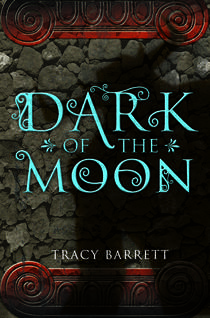
Barrett’s most recent novel is Dark of the Moon (Harcourt, 2011), a very clever re-imagining of the myth of Theseus and the Minotaur. The story is told mostly from the point of view of Ariadne, a young woman about to become the moon goddess of Krete. Ariadne’s misshapen brother Asterion is the captive Minotaur monster to whom Theseus will be sacrificed.

Barrett writes characters that must face the mundane challenges of daily living with as much courage as is required for the more heroic contests of legend. This quality lends a sense of credibility and even modernity to the story. When I asked her about this, she explained:

I don’t think it’s true that people are people; that we’re all the same no matter where or when we live. If that were the case, there would be no such science as anthropology or sociology! But I do believe there are some constants. At the beginning of “King of Ithaka,” for example, Penelope has to find Telemachos’ shoes for him. Ask any mother of a teenager, and she’ll tell you that boys have shoe-blindness. I bet that was true in the Iron Age as well! I also think that teenagers have always and will always flirt, feel caught between childhood and adulthood, be easily embarrassed, simultaneously crave and fear adventure. I really enjoy exploring these familiar emotions in an unfamiliar setting.

When I asked why students should read the classics, Barrett replied:

The most important reason is that the classics are wonderful stories. They wouldn’t have come down to us if they weren’t. For any ancient tale to have survived is miraculous—someone had to love it enough to write it down (both the Iliad and the Odyssey were originally told orally), and then it had to be copied over and over again in order to survive thousands of years. Paper and parchment were expensive, so they were reused and repurposed if what was written on them wasn’t considered important enough to save (some important ancient writings were reused as mummy wrappings in Egypt!). If a book wasn’t loved and taken care of, it would rot or fall apart or be eaten by bugs. So lots of people had to have loved these stories in order for them to make it to the twenty-first century. They can’t all be mistaken.

Tracy Barrett had a lot more to say about studying the classics, her writing, and these stories. I thoroughly enjoyed our conversation and I learned a lot. Please read the full interview on my March 2012 blog post. 


M.D. Clark reads Greek, Norse and Irish myths to her children. 

An Interview with Tracy Barrett


Tracy Barrett is the author of a number of books for young adult readers including Anna of Byzantium and The Sherlock Files mysteries. She talked with me about her two most recent novels, Dark of the Moon and King of Ithaka.  


MDC: Current literary trend seems to be to take the gods and monsters of myth and put them in the modern world. Your approach is different …

TB: Yes, I enjoy reading those books but I prefer trying to re-create the ancient world!

 … and in a way, your stories have a kind of “modern” feel. Can you explain?

I don’t think it’s true that people are people; that we’re all the same no matter where or when we live. If that were the case, there would be no such science as anthropology or sociology! But I do believe there are some constants. At the beginning of King of Ithaka, for example, Penelope has to find Telemachos’s shoes for him. Ask any mother of a teenager, and she’ll tell you that boys have shoe-blindness. I bet that was true in the Iron Age as well! I also think that teenagers have always and will always flirt, feel caught between childhood and adulthood, be easily embarrassed, simultaneously crave and fear adventure. I really enjoy exploring these familiar emotions in an unfamiliar setting.

The spelling of some words may be different than the reader is used to (for example: Aegyptian, qat, kyklops). Why?

The spellings usually used in English are latinized versions of Greek names/words. For example, Greek didn’t have the letter “c” and Latin didn’t have “k,” so the Greek “Kyklops” became “Cyclops” in Latin. Many masculine nouns in Greek end in “-os” but in “-us” in Latin. English adopted the Latin spelling, but Latin wasn’t a major language for quite a while after the time when my story takes place, so I used something closer to the original Greek—I didn’t see why I should use Latin spelling just because the Romans didn’t feel like using “k” or “-os”!

I wasn’t 100% consistent, though. In some cases I kept a more familiar spelling so that my reader would know what I was talking about. I didn’t think they would recognize the Sirens if I called them Seirenes, the more accurate rendering of the Greek word!

“Aegyptian” and “qat” are a bit different. I used an antiquated spelling of “Egypt” and a spelling of the word that “cat” might possibly derive from. Both Egypt and cats are very familiar to my readers—I hoped that by using an unfamiliar spelling I would show how exotic they were to Telemachos.


Telemachos is afraid of the sea, not adept at lighting fires – he’s a bit unexpected for the son of Odysseus. What were your thoughts about his childhood?

I think that both Telemachos and Penelopeia have a lot of fears that govern large parts of their lives. Telemachos knows that his father sailed away and never returned; therefore, the sea naturally holds a lot of terror for him. He also doesn’t have any kind of role model; his grandfather is old and befuddled, and most of his neighbors are greedy and lazy. Somewhere inside of him he knows that he really needs to man up, but he’s so afraid of growing up (and also, he has a pretty cushy life) that he closes his eyes to the abuses going on in his home.

Penelopeia also doesn’t want him to grow up. It’s easier to spoil him, not make him work, and indulge him, than to allow him to face the suitors and perhaps lose his life by challenging them.


From what I remember of Homer, Odysseus is manly and gentle when not battling. Your Odysseus is quite different. Tell me more about him.

One of the main points I’m trying to make in King of Ithaka is that poets/novelists/singers/painters/journalists have a huge role in how we think of people and events. Homeros has to flatter his patron and praise all the major players on the Greek side in the Trojan War. Of course he would show Odysseus in a positive light—he’d lose his job as court poet if he didn’t.

But Homer is a very subtle poet. If you read the Odyssey with an open mind, trying to forget the movies and other places you’ve seen him, Odysseus starts looking like a jerk. Dante had it right—Odysseus lies and lies. Sometimes he lies to save his skin, but sometimes it looks like it’s just for the heck of it. Plus, he had a lot of opportunities to go home that he didn’t take advantage of. If he was so eager to return to Ithaca and his family, why did he hang out with Calypso for seven years without making any attempt to escape? Why did he stay with Circe for a whole year, instead of sailing off immediately after he made her turn his sailors from pigs back into men?


The conclusion of the story is fascinating – unexpected and yet, inevitable. Did any of it come from Homer, or did you follow your imagination?

 I was really stuck about that for a long time. I fully intended to end King of Ithaka with the slaughter of suitors, as Homer told it. But when I got there, I knew that the Telemachos that I had written just could not participate in such a thing. So I changed it in a way that I hope is true to my character and to my story.

And as for what happened to Odysseus, there are actually three different versions of his life post-return to Ithaca (Homer wasn’t the only one who told his story—I’m just the most recent in a long line of re-tellers):
  • Odysseus ruled in Ithaca until the end of his days
  • being sick of the sea, he walked inland until someone didn’t recognize the oar over his shoulder and asked, “What are you doing with that winnowing-fan?”
  • he sailed through the Straits of Gibraltar and never returned
The last version is the one adopted by Dante, who shows Odysseus in the Circle of Liars in Hell, in his Divine Comedy. Speaking from inside the flame that burns him for eternity, Odysseus tells Dante and Virgil that he convinced his sailors to sail with him through the Straits of Gibraltar in search of adventure (the ancients thought that the Pillars of Hercules were a signpost that you shouldn’t go any further west than Spain). Odysseus uses every rhetorical trick in the book to convince his sailors to do this forbidden thing—his speech is a masterpiece of how to use words to manipulate people to do wrong. I paraphrased that speech in King of Ithaka!


In Dark of the Moon, the first person narration alternates between Ariadne and Theseus. Why did you choose to write Ariadne’s narration in the past tense and Theseus in the present?

First, I needed to differentiate their voices. I wanted a reader to be able to open the book at random and know which one was speaking. (Change of tense was only one way I did this—look at their sections and see which one is confused and asks a lot of internal questions and which one never does—not even once!) Second, Ariadne is rooted in the past. Her religion and her tradition have not changed in millennia. It’s logical that she would think in the past. Theseus is a man of the now. He doesn’t have much of a past—never even knew who his father was until shortly before the main action of the book—and he doesn’t think he has a future. The present tense was natural for him.


The mercy killing of Asterion calls to mind that decisive scene in Steinbeck’s Of Mice and Men. Had you planned it early on, or did it unfold as the story ran its course?

I knew that Theseus had to kill Asterion, but I also knew from the beginning that I wanted the motivation for the killing to change from mere survival, as in the myth. I wasn’t sure if the it was going to be self-defense or a mercy killing, so I had to wait until I got into the book and knew the characters better before I decided. The mercy killing seemed more natural.


The presence of the gods in your stories is very subtle, unlike the interfering sort we are used to. Tell me why.

Most ancient Greeks believed that although the gods could and did interfere in human endeavors, they weren’t interested enough in people to do so very often (they’re often portrayed as essentially lazy and self-absorbed). They participated in wars and great political events, that kind of thing—and if a particularly attractive human being caught their eye, they might make a play for them! But they weren’t terribly concerned with our day-to-day activities. The gods in my books are the same way.

In King of Ithaka, I also made sure that it was never crystal-clear that it was actually a god that Telemachos was talking to. It could have been an over-active imagination, a dream, wishful thinking.

I did make centaurs, satyrs, etc. a part of everyday life, however. This is because when I decided that Telemachos needed a best friend, he kept popping into my mind as a centaur. I told myself, “No! You’re not writing fantasy!” and turned him back into a boy, and he kept turning back into a centaur. So I finally said, “Fine, he’s a centaur.”


Why should students study the classics?

The most important reason is that the classics are wonderful stories. They wouldn’t have come down to us if they weren’t. For any ancient tale to have survived is miraculous—someone had to love it enough to write it down (both the Iliad and the Odyssey were originally told orally), and then it had to be copied over and over again in order to survive thousands of years. Paper and parchment were expensive, so they were reused and repurposed if what was written on them wasn’t considered important enough to save (some important ancient writings were reused as mummy wrappings in Egypt!). If a book wasn’t loved and taken care of, it would rot or fall apart or be eaten by bugs. So lots of people had to have loved these stories in order for them to make it to the twenty-first century. They can’t all be mistaken.

Also, we get a window into our own history. We often think of people of the past as being monolithic. We say “the ancient Greeks believed X” or “in the Middle Ages, everyone thought Y” as though they all had one mind, one set of beliefs. It’s wonderful to see how refreshingly individual they are, to see the humor, the drama, the love stories that are as real to us today, despite differences in culture, as they were to the people who wrote them.

There’s an educational reason too, although I hesitate to bring it up, because that makes the classics sound like medicine—something that’s unpleasant but that you should put up with, because it’s good for you. But there are so many references to the Greeks, the Romans, people from medieval history, the Renaissance in movies, books, comic books, paintings, that you get a whole new layers in them if you recognize the references. Read the Iliad and then watch Star Wars—you’ll be amazed at how much similarity you’ll see and how much the story is enriched for you.


Do you think there is any danger of mythology causing confusion for children brought up in a particular religious faith?

If a child is brought up in such a bubble that he or she is unaware that not everybody has the same beliefs as his or her family, that child is headed for a lot more confusion than my book could ever provide! Parents should have enough confidence in the way they raise their children that they shouldn’t be afraid that all those years of careful nurturing and education will be overturned by a book—or by ten books. Books are powerful, of course, but a parent’s loving teaching is much more powerful.


Do you have a favorite myth?

Just one??? I don’t think I can narrow it down that far! The one that’s most on my mind these days is the story of the Minotaur, since I recently wrote Dark of the Moon, which is a retelling of that story. 


I am always curious about how people write. Do you begin at the beginning and go from there? Do you first know where you want to end up and then figure out how to get there? Is your writing process different when retelling a familiar story?

I start from the beginning and work my way through. I always have at least a vague idea of how it will end, but lots of things change as I go.

I often go back as I write, and change events or strengthen or weaken a character’s personality once I know her or him better. For example, in my current work in progress, I started off thinking that my narrator, who has lost everyone dear to her, is motivated by wanting to be loved. I’m realizing now that it’s just as important for her to have someone to whom she can give love, and I’m finding places earlier in the manuscript to make that clear.

I also sometimes write an episode or scene as it occurs to me, and save it in an “idea file.” I don’t always use those ideas, but I often do.


Are you writing anything now?

I’m always writing something! Right now I’m in the middle of the first draft of a novel about an Etruscan slave girl who is brought to the city of Pompeii just before the eruption of Mt. Vesuvius. I also have another myth re-telling in mind but I’m forcing myself not to start it or even think about it too much until I finish the Pompeii story.


Wednesday, February 1, 2012

Fairly Odd Tales

Fairy tales are an important part of our collective heritage. The Frog Prince, Red Riding Hood, Cinderella - these legendary tales provide entertainment, escape and a unity of understanding. They are a shared experience that crosses many cultures and continents.

J. R. R. Tolkien, author of the epic Lord of the Rings trilogy, asserted that fairy tales are supremely suited to, “giving a fleeting glimpse of Joy.” Read his essay, “On Fairy Stories,” for some insight into the origins and use of fairy tales.

Read fairy tales by the brothers Grimm and Hans Christian Anderson with your family. Fairy tale literacy enables your children to take part in the Great Conversation.

Then branch out and have a little fun with some delightfully irreverent books like these, which gleefully spoof the classics.


The Three Little Aliens and the Big Bad Robot
by Margaret McNamara
Schwartz & Wade Books, 2011
ages 3 and up

Three aliens go out into the universe to seek their fortunes and are pursued by a whooshing, beeping giant robot who threatens, “I will crack and smack and whack your house down.”

The dark reaches of our starry solar system provide an eye-catching backdrop for cute green aliens and an impressively fierce robot. Great looking and silly, this book is an out-of-this-world lampoon of the Three Little Pigs.


Falling For Rapunzel
by Leah Wilcox
Puffin, 2003
ages 3 and up

Poor Rapunzel in her tower is having a bad hair day. Her diffuser doesn’t seem to be doing its job, and neither does her maid - clothing and accessories litter the floor and there’s underwear on top of her computer.

A handsome prince hears her whining and calls to her, but confused Rapunzel cannot hear him correctly and instead of letting down her hair, she tosses all sorts of ridiculous items out the tower window.

The rhyming couplets are charming and the acrylic and paper montage illustrations pop with cheery humor. This is a fun Valentine’s Day tale, as it ends with romance and practicality.


The Stinky Cheese Man and Other Fairly Stupid Tales
by Jon Scieszka and Lane Smith
Viking, 1992
ages 6 and up

From title page to end papers, this wacky book is the ultimate example of fairy tales gone berserk. Deranged illustrations and delirious font changes are strong indications that stories such as, “Little Red Running Shorts,” and “Jack’s Bean Problem,” are going to be quite unorthodox and extremely silly.

Theatre IV is putting this one on stage at the Empire Theater from February 17 to March 18, 2012. I haven’t seen it, but director Billy-Christopher Maupin kindly shared a script so I can tell you that it is very much like the book - outlandish and rowdy.

This show is either going to be a blast or a bomb; my guess is that it will be a rollicking good time. The folks at Theatre IV are brimming with talent and their productions are always top-notch. If you saw "A Year With Frog and Toad" over the holiday, then you already know how great Theater IV really is.

A few words of caution before bringing the very young: the show will be confusing if a child isn’t already familiar with the classic fairy tales, and the word “stupid” is used quite a lot. It is always in reference to the tales and not used to insult characters, but still can be strident for those who have taught young children that “stupid” is a bad word. There’s also the use of “flippin’” once, which, let’s face it, is just a substitute bad word. And, be aware that one character is aptly named Cow Patty Boy.


CLASSIC CHOICE

The Practical Princess
by Jay Williams
Parents Magazine Press, 1969
ages 5 and up

Hard to find, but well worth the search, this book is a true gem. When reading it to schoolchildren, I find that boys and girls alike are highly entertained by this story. Even a year later they still tell me, “I really like that princess story.”

The fable seems rather typical at first: a dragon moves in and demands that the princess be sacrificed to him, or he will destroy the kingdom. So now we expect a prince to enter the scene and save the day.

But in this tale, the lovely, graceful and practical Princess Bedelia must save herself with her quick wits. “Use your common sense,” she says, “He’s just asking for me because he’s a snob.” Bedelia has her gaudiest dress stuffed with straw and a hundred pounds of gunpowder, and heaves it down the dragon’s throat. No more dragon problem.

But all is not peaceful in Arapathia, because of Lord Garp of Istven, a crafty, greedy man with a face, “like an old napkin.” He threatens war if Bedelia doesn’t marry him. Princess Bedelia’s clever thinking saves her kingdom and herself, and also rescues Prince Perian from Lord Garp’s evil spell. 

With strange and wonderful pictures by Friso Henstra, this storybook is as good as it gets.


M.D. Clark appreciates the value of Aesop's fables, but finds them frustratingly short and cannot sink her figurative teeth into them.

Sunday, January 1, 2012

Better Late Than Never: Upon Reading "The Phantom Tollbooth" by Norton Juster

Dearest Mr. Norton Juster:

Fifty years is a very long time, is it not? Actually, I can only imagine how it feels because your book, The Phantom Tollbooth (Knopf, 2011), which is celebrating its 50th anniversary, was birthed a few years before I. And that’s where some embarrassment sets in for me. Although the book was always in the library during my growing-up years, and though other kids gave oral reports in elementary school and it was highly recommended by librarians, I never read it until just now.

You see, Mr. Juster, I was a rather persnickety child who literally judged a book by its cover.  True! Certainly, no book was worth reading if it had the word “tollbooth” in the title. My parents drove me through tollbooths twice a day and I knew them to be dirty, congested, panic-inducing (“Look under the floor mats for more change!”) harbingers of tardy slips and detentions. And what's up with that dog/clock thing?

So for years I took a pass on your book. Sorry.

Today, I comprehend the extent of my former foolishness. Why, reading The Phantom Tollbooth reminds me of many wonderful books I’ve enjoyed through the years such as the Book of Nonsense by Edward Lear, John Bunyan’s Pilgrim’s Progress, and Lewis Carroll’s Alice’s Adventures In Wonderland.

And it makes me remember my formerly childish self. Your main character is a boy named Milo who “didn’t know what to do with himself – not just sometimes, but always ... Nothing really interested him – least of all the things that should have.” Well, that’s just like sixth-grade me.

The sighing Milo passes through a mysterious tollbooth and finds himself in a place called Expectations. There he meets the first of many peculiar characters he will encounter.

Mr. Juster, I think you got the idea for some of these idiosyncratic beings from my own family.

In his travels, Milo learns the history of the kingdom of Wisdom and its two great cities: Dictionopolis (the city of words) and Digitopolis (the city of numbers). The princesses Rhyme and Reason kept these two cities in harmony until they were banished, causing Wisdom to fall into disrepair. 

To restore Rhyme and Reason, Milo must jump to Conclusions, swim the Sea of Knowledge and face the forbidding Mountains of Ignorance where dwell demons such as the Threadbare Excuse, the Gross Exaggeration and the Overbearing Know-it-all. An impossible task, yes, but Milo can do it simply because he WILL do it.

Mr. Juster, The Phantom Tollbooth is brilliant and nonsensical, playful and logical. Your frolicsome treatment of conventional idioms leaves me feeling like I am having tea with the Mad Hatter. This “linguistic mayhem,” as you once called it, is utterly delightful to clever children and astute adults alike. What fun!

And you, Mr. Juster, must be an extremely comprehending sort of person to understand that a big pencil is really a magic staff because “once you learn to use it, there’s no end to what you can do.”

Your fable brims with delightful morsels of wisdom and sagacious lessons to be thought about over the journey of a lifetime. I feel a little younger and a little smarter, too, for having read your book.

Happy 50th anniversary, Milo, Humbug and Tock! Sorry I’m so late in coming to the party.

Your newest fan,

M. D. Clark


P. S.  Mr. Juster, your new picture book for kids ages 4-8, Neville (Schwartz & Wade, 2011) is marvelous, too. The mixed media illustrations by G. Brian Karas perfectly capture the changing emotional tone of your story.

It opens on a lonely boy in a colorless neighborhood. His back is to the reader and he gazes into nothingness as a moving van leaves the scene. Lonely and sad, the boy walks a little way then takes a deep breath and shouts the name “Neville” into the air. Shortly another boy joins him and advises him to shout louder because “he probably can’t hear you.” They shout together. More children join them and take up the call.

With each child comes a little more color and life doesn’t look so bad anymore for this young man. The charming ending came as a complete surprise to my youngest son. Now he’s a Juster fan, too.


CLASSIC CHOICE

Juster’s Phantom Tollbooth reminded me of several classics that you might enjoy, some of which were mentioned above. Another timeless book for the whole family is The Little Prince (Harcourt, 1943), by Antoine De Saint-Exupery.

Saint-Exupery’s classic story is another book that grows with the reader. A child hearing the story will have a very different impression than a teen reader, and an adult’s understanding will be different still.

A narrator recalls the events of six years before when he, a pilot, was stranded in the desert. He wakes to find a surprising little boy standing before him, asking for a drawing of a sheep. This little prince from asteroid B-612 finds the ways of grown-ups to be very strange, for grown-ups, it seems, tend to be rather selfish, narrow-minded and lacking in imagination.

The bittersweet parable was written in French. Katherine Woods’ translation has been the standard in English until recently, and it may be difficult to get a copy, but it is worth the try. Richard Howard’s omnipresent new translation from 2000 is adequate, but lacking the lyrical tenderness of Woods’ work.

Thursday, December 1, 2011

Something for Everyone on Your List

  
Do you find yourself wondering what will be the perfect gift for friends and family this Christmas? Why, a book, of course!

Just for you, I’m revealing my top-secret gift list. These books deserve a bookmark because I know our family will get a lot of mileage out of them; they will be read many times by the recipients and traded around among siblings and friends.  Though I have categorized each book for a specific child, they really aren't limited to that particular age or gender.

 For the baby:

Rescue: Pop-up Emergency Vehicles 
and 
Puppies, Kittens and Other Pop-up Pets 
by Matthew Reinhart
Robin Corey Books, 2011

Matthew Reinhart is the creator of extraordinary works of pop-up art, including, “Star Wars: The Pop-up Guide to the Galaxy,” and the “Encyclopedia Mythologica” trilogy.  They are intricately made for careful hands and are too expensive to give to your youngest readers for fear of damage.

Now Reinhart has produced two books for the wee ones. The friendly pop-up spreads, moving pictures and flaps that open are a delight to young eyes. They’re far sturdier than expected and reasonably priced so you don’t cringe over their inevitable demise.


For the 7-year-old boy:

Mameshiba: On the Loose! 
by James Turner 
VIZ Media, 2011

Cute and colorful, the trivia-loving Japanese “bean dog” characters in this graphic novel have a droll sense of humor. Led by brave Edamame, these intrepid legumes are off on two eccentric adventures: facing mutant sewer chickens (“terrifying monsters made of living sewage and discarded chicken parts. Plus a secret blend of herbs and spices.”), and exploring the far reaches of outer space.

Though it looks like a kiddie comic, the humor is sophisticated enough for a wide audience.


Learning to Ski with Mr. Magee
by Chris Van Dusen
Chronicle Books, 2010

Mr. Magee and his happy dog, Dee,
Star in this riotous story about learning to ski.
It’s written in couplets that cleverly rhyme,
And make reading aloud a jolly good time.
The pictures are funny, the story preposterous,
You’ll laugh so hard you may hurt your esophagus.


For the 9-year-old boy:

The Secret Science Alliance and the Copycat Crook 
by Eleanor Davis 
Bloomsbury, 2009

Ultra nerd Julian Calendar has a plan to fit in at his new school. He’s trying to hide his super smarts to fit in with the cool and sporty crowd. When Julian fails to disguise his scientific brain in front of his class, he isn’t vilified. Instead, the “dumb jock” and the “dangerous maniac” let him in on their own big secret – they’re nuts about science, too. Together they form the Secret Science Alliance, soon finding themselves in a battle with the evil, invention-notebook-stealing Dr. Stringer.

Eleanor Davis has created a fun graphic novel with a lively story and incredibly detailed drawings. She breaks down stereotypes and celebrates talented young minds without a hint of sermonizing. The book is so entertaining, kids will wish for more SSA adventures.


Howtoons: The Possibilities are Endless 
by Saul Griffith, Nick Dragotta and Joost Bonsen 
Collins, 2007

This handy comic book opens with mom’s classic query, “Can’t you kids make something other than trouble?”  That’s when friends Tucker and Celine create their own workshop and go to town on some great building projects.

For the cub scout who loves to use tools, this is a great gift. The book illustrates, in comic book style, step-by-step instructions for making a marshmallow shooter, a rope swing, a simple electric motor and more. Also included are lessons in safety and the proper use of tools. The projects vary in degree of difficulty. Supervision is recommended, of course.


For the 11-year-old girl:

Zita the Spacegirl 
by Ben Hatke 
First Second, 2011

Zita and Joseph happen upon a meteoroid crater containing a device with a large red button. Though Joseph warns her not to, Zita pushes the button and, suddenly, Joseph is sucked into a vortex and disappears. Zita is horrified and can think of nothing to do except run away in fear, but guilt and worry eventually lead her back to the jumpgate and she summons the courage to follow her friend.

Clean design and a muted color palate make this graphic novel easy to follow and a pleasure to read.  Ben Hatke has created an outer space adventure with elements that may remind you of sci-fi movies you’ve seen; that slightly familiar feeling makes Zita’s unique quest seem plausible. Zita and her companions exemplify the virtues of courage, loyalty and self-sacrifice. Readers will cheer for them.


The Last Dragon 
by Jane Yolen
Dark Horse Books, 2011


The bewitching illustrations in this fairytale graphic novel will surprise you. Yes, this is another village-versus-dragon story, but it is intelligently revisited and, as it turns out, is a compelling story.

The healer’s daughter and a heroic-looking young man must use the seemingly small talents they possess to deal with the very large problem of a dragon. Though tempted to run away from their predicament, they choose the road less traveled and prepare for battle. But even with the villagers’ help, how can they possibly win?

This romantic adventure has great presentation; the larger-sized hardbound tome feels somehow ancient and otherworldly.  

For the cousins and friends:

The Carpenter’s Gift: A Christmas Tale About the Rockefeller Center Tree, by David Rubel (Random House, 2011). 

I am always reluctant to read new holiday stories because they are so often disappointing, but this simple story gets my Bookmark. Sentimental without the sap, this story follows young Henry and his father who borrow a truck to sell Christmas trees in Manhattan where men, grateful to have work, are building Rockefeller Center. It is 1931 and times are hard.

“The best presents are the ones you don’t expect,” thinks Henry. Indeed, there are many unexpected magical moments in this lovely story. The spirit of Christmas shines so brightly readers may be tempted to think it a true story. Warm illustrations sparkle with the love of family and glow with the joy of giving.
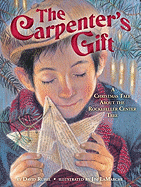
Rubel’s book is a gift that will be enjoyed year after year.


M. D. Clark’s family never misses the youth Christmas show at the Swift Creek Mill Theater. See ya there!   
http://www.swiftcreekmill.com